The First Amendment of the Bill of Rights
Seeing the Big Picture
Share to Google Classroom
Recommended Activity
Published By:
National Archives Foundation
Historical Era:
Across Eras: Civics & Government
Thinking Skill:
Historical Comprehension
Bloom’s Taxonomy:
Understanding
Grade Level:
Upper Elementary
Suggested Teaching Instructions
This activity may be taught following an introduction to the Bill of Rights and First Amendment. For grades 3-5. Approximate time needed is 20-30 minutes.
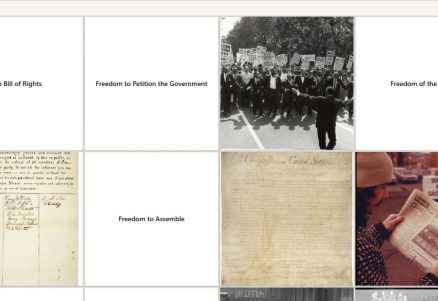
Choose one document in the grid to model careful document analysis and matching for students.
Students should match each document with the specific right in the First Amendment that it best illustrates. This activity may also be completed by dividing the class into pairs or small groups.
After concluding the activity, lead a discussion with students about the documents they examined.
Ask students to determine which right they feel is the most important to them. Direct students to write a paragraph on which right they feel is the most important and why.
To the extent possible under law, National Archives Foundation has waived all copyright and related or neighboring rights to “The First Amendment of the Bill of Rights”
Description
In this activity for upper elementary grades, school students will analyze primary sources and match them with the rights extended to Americans by the First Amendment of the U.S. Constitution.
Share this activity with your students
Documents in this Activity
Chinese Buddhists at the Temple of Enlightenment, Bronx, New York
Contemporary United States (1968 to the present)
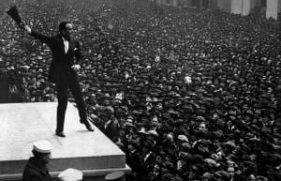
Douglas Fairbanks, movie star, speaking in front of the Sub-Treasury building, New York City.
The Emergence of Modern America (1890-1930)
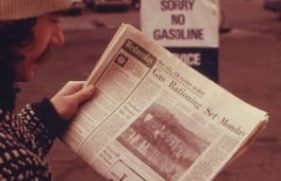
Gas Rationing System (Odd-Even Plan) is Announced
Contemporary United States (1968 to the present)