

Analyzing the Equal Rights Amendment

Analyzing Documents
Share to Google Classroom

Recommended Activity
Published By:
National Archives Foundation
Historical Era:
Contemporary United States (1968 to the present)
Thinking Skill:
Historical Analysis & Interpretation
Bloom’s Taxonomy:
Analyzing
Grade Level:
Middle School
Suggested Teaching Instructions
This activity is appropriate in a study of women’s rights, second-wave feminism, and the 1970s. For grades 5-8. Approximate time needed is 20 minutes.
Students can work on the activity individually, in pairs, or as a full class. Direct students to begin by taking a minute to examine the document, then responding to the questions that follow, which will guide them through the process of written document analysis:
- Meet the document.
- Observe its parts.
- Try to make sense of it.
- Use it as historical evidence.
If necessary, check in with your students at each step in the process and model analysis if required.
After completing and discussing the analysis questions, direct students to click on “When You’re Done.” Share the following historical context, if necessary:
The Equal Rights Amendment (ERA) was first introduced in Congress in 1923 by Susan B. Anthony’s nephew, Congressman Daniel R. Anthony. Drafted by Alice Paul, a leader in the fight for women’s rights, it was proposed as a way to end discrimination against women.
This Constitutional amendment was reintroduced at every subsequent session of Congress for 49 years. Supporters believed it would provide full equality for women; opponents considered it unnecessary, and some believed it destructive of the family.
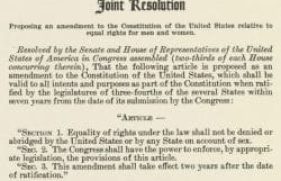
In 1972 the amendment passed both houses of Congress and was submitted to the State legislatures on March 22, 1972 for ratification. (The joint resolution, a formal opinion adopted by both houses of the legislative branch, is shown here. A constitutional amendment must be passed as a joint resolution before it is sent to the states for ratification.)
When the deadline for ratification by the state legislatures passed in 1982, It was three states short of the required 38 (three-fourths of the States). It remains unratified.
Students should respond to the following question that is provided:
- Should an Equal Rights amendment be passed today? Why or why not?

To the extent possible under law, National Archives Foundation has waived all copyright and related or neighboring rights to “Analyzing the Equal Rights Amendment”
Description
In this activity, students will carefully analyze the joint resolution proposing the Equal Rights Amendment (ERA) to the Constitution of the United States.