


To What Extent was Reconstruction a Revolution? (Part 2)

Spotlight
Share to Google Classroom
Recommended Activity
Published By:
National Archives Foundation
Historical Era:
Civil War and Reconstruction (1850-1877)
Thinking Skill:
Historical Analysis & Interpretation
Bloom’s Taxonomy:
Evaluating
Grade Level:
High School
Suggested Teaching Instructions
Guiding question: To what extent was Reconstruction a revolution?
1. Discuss guiding question
If Part 2 will be done with the whole class, ask the students to share their responses to the guiding question, taking into account information from all seven of the documents as well as the introductory discussion on revolutions in Part 1.
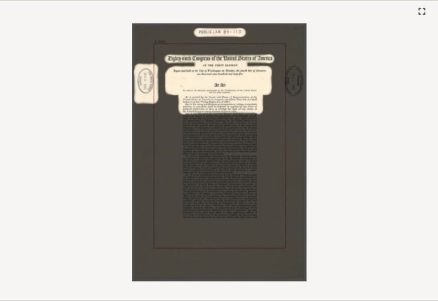
2. Examine the Voting Rights Act of 1965
Open the activity in Part 2 so that students can see the Voting Rights Act of 1965. Hold a class discussion on this document. Ask students to compare the date of this document to the date of the constitutional amendment it was created to enforce.
- Why did this document come 95 years after the 15th Amendment?
- Was it part of the same revolution as Reconstruction? Or is it part of a new revolution?
- Was there a revolution?
- Does this document change your answer to the guiding question? Why or why not?
Students working individually or in groups can email their responses to these questions in anticipation of further class discussion.
3. Re-examine answers to guiding question
Return to full class discussion of the guiding question—To what extent was Reconstruction a revolution?
- How quickly must change occur to be considered revolutionary?
- How long must significant change last in order to be called revolutionary?
- Looking at the actions of Congress as seen through these historical congressional records, does Congress initiate revolutionary change or merely reflect it?
- Do you have enough information to answer the guiding question?
- What other information would be helpful to have to answer it?
- What other documents or sources should be examined to help answer the question?
After discussion, students can revise their answer to the guiding question, or explain why they their answer has not changed.
4. Lesson extension
Ask students what document, if it existed, could help answer the guiding question. Brainstorm a list of questions that remain unanswered after having reviewed the documents, as well as questions raised by the documents themselves. Direct students to create the “missing” document, complete with details such as letterhead, stamps, handwritten notes, images, etc., and then explain how this document fills in the hole in the story. Have students explain the likelihood/possibility that something like this document actually exists, and if so where.

To the extent possible under law, National Archives Foundation has waived all copyright and related or neighboring rights to “To What Extent was Reconstruction a Revolution? (Part 2)”
Description
This activity is a continuation of To What Extent was Reconstruction a Revolution? (Part 1). Students will examine the Voting Rights Act of 1965 and determine whether their analysis of this document changes their responses to the guiding question regarding the revolutionary nature of the Reconstruction era.

