

To What Extent was Reconstruction a Revolution? (Part 1)

Weighing the Evidence
Share to Google Classroom

Recommended Activity
Published By:
National Archives Foundation
Historical Era:
Civil War and Reconstruction (1850-1877)
Thinking Skill:
Historical Analysis & Interpretation
Bloom’s Taxonomy:
Evaluating
Grade Level:
High School
Suggested Teaching Instructions
This activity may be used at the conclusion of a unit of study on the Reconstruction era. The activity can be completed as a class, in small groups, in pairs, or individually. The activity comes in two parts which together require 45-60 minutes. This lesson is most appropriate for grades 10-12. Part 2 of the activity is located here.
Guiding question: To what extent was Reconstruction a revolution?
Learning Objectives: Students will be able to compose an answer to the guiding question: To what extent was Reconstruction a revolution? Students will examine documents illustrating multiple perspectives; form opinions relating to the amount of change depicted, and back up their opinions verbally or in writing.
Students will recognize the unique aspects of historical records of the U.S. Congress. Records from the legislative branch often capture “history in the making” in the ongoing process of creating legislation. This aspect of congressional records allows the students to see a moment in time, even though aspects of proposed laws may be later amended or repealed.
1. What is a revolution?
Introduce the guiding question to students and hold a class discussion about revolution. Questions can include: What is a revolution? What other topics have students studied that were called revolutions? What features made them revolutionary? What might you expect to see if a revolution indeed occurred? How significant must change be in order to be called revolutionary? Can a revolution affect some aspects of society and leave others untouched? How quickly must change occur to be considered revolutionary? How long must significant change last in order to be called revolutionary? Encourage students to think about their responses to these questions throughout this activity.
2. Document analysis
The document analysis can be done in small groups, pairs, or individually. Review careful document analysis with students before assigning the activity. Students will examine seven documents and assess the extent to which each document illustrates revolutionary change occurring during the Reconstruction era. Students will place the documents on a scale to indicate their assessment that “Yes, the changes which occurred in the nation amount to a revolution” or “No, the changes which occurred in the nation fell short of revolutionary.” Call students’ attention to the document details for each record which may provide helpful contextual information.
After completing the activity, students will email to the teacher their responses to the following questions:
- What evidence did you see in the documents which illustrated significant change occurring?
- What evidence depicted things staying the same?
- Taking into account information from the documents as well as the introductory discussion on revolutions, answer the guiding question: To what extent was Reconstruction a revolution?
3. Part 2 of the lesson
Students may continue on to To What Extent was Reconstruction a Revolution? (Part 2) in their groups or individually, or the teacher may continue to Part 2 as a whole class discussion session.
Teaching instructions for What Extent was Reconstruction a Revolution? (Part 2) are located here. The student activity is here.

To the extent possible under law, National Archives Foundation has waived all copyright and related or neighboring rights to “To What Extent was Reconstruction a Revolution? (Part 1)”
Description
Students will examine several historical congressional records from the Reconstruction period to assess whether they show evidence that the Reconstruction period of American history should or should not be viewed as a revolution. The documents used in this activity come from the historical records of the U.S. Senate and U.S. House of Representatives.
Share this activity with your students
Documents in this Activity
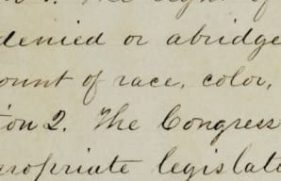
Joint Resolution Proposing the Fifteenth Amendment
Civil War and Reconstruction (1850-1877)

Memorial Against Integration of Public Schools
Civil War and Reconstruction (1850-1877)

Memorial of the Colored People of Georgia in Favor of the Sumner Civil Rights Bill
Civil War and Reconstruction (1850-1877)