

The SS Quanza and European War Refugees

Finding a Sequence
Share to Google Classroom
Recommended Activity
Published By:
National Archives Foundation
Historical Era:
The Great Depression and World War II (1929-1945)
Thinking Skill:
Historical Analysis & Interpretation
Bloom’s Taxonomy:
Analyzing
Grade Level:
High School
Suggested Teaching Instructions
Students should be familiar with the basic facts of the Holocaust and World War II. For grades 8-12. Time needed is approximately 60 minutes. The activity can be done individually or in pairs.
Begin the activity by introducing students to the events that set in motion the refugee crisis (links go to the United States Holocaust Memorial Museum’s “Americans and the Holocaust” online exhibition):
- The failure of the Evian Conference of 1938 to influence governments to relax their immigration restrictions
- The Immigration Act of 1924 and U.S. immigration policy during the 1930s and 1940s (If time permits, ask students to complete the Impact of the Immigration Act of 1924 on DocsTeach before beginning this activity.)
- The fate of the MS St. Louis, which was an unsuccessful attempt to bring refugees to Cuba and the United States.
Post a timeline of these and other significant events for students to reference.
Show students the letter from Attorney E.C. Powell to the Secretary of State (included in the activity) regarding strengthening immigration laws. Model document analysis, and speculate for whom it was written, its content, and why it was created. Ask students:
- What do you notice about the style the writer employs in this letter?
- What facts can we deduce from this document?
- What does the writer hope to achieve?
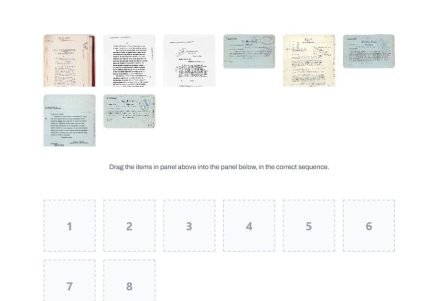
Direct students, individually or in pairs, to open the activity and chronologically sequence the documents. Instruct them to analyze each document before moving it to its proper place in the bottom panel. Ask them to make a list of arguments for and against broadening immigration to refugees.
After sequencing the documents, students should click on “When You’re Done” and respond to the questions provided:
- What were the perspectives on the refugee crisis from the Executive and Legislative branches?
- Within the Executive Branch, were there any differences between the President and members of his cabinet? What were they?
- What role did private citizens play in the crisis?
When students have finished, discuss the questions as a class and ask students to identify the various methods or strategies used to influence the decision whether or not to admit the Quanza’s passengers.
This activity was created by National Archives volunteer Cynthia Peterman.

To the extent possible under law, National Archives Foundation has waived all copyright and related or neighboring rights to “The SS Quanza and European War Refugees”
Description
In this activity, students will analyze documents pertaining to the refugee crisis during World War II. From their analysis, they will learn about U.S. Government immigration policy and the role of private citizens trying to influence official policy. They will compare and contrast attitudes on immigration during a turbulent period in modern history.
Share this activity with your students
Documents in this Activity
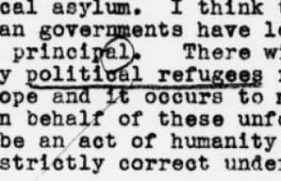
Memorandum for the Secretary of State from FDR
The Great Depression and World War II (1929-1945)

Telegram from Passengers on the Ship Quanza to Eleanor Roosevelt
The Great Depression and World War II (1929-1945)
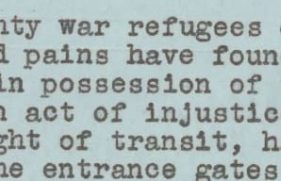
Telegram from Passengers on the Ship Quanza to President Roosevelt
The Great Depression and World War II (1929-1945)