In this activity, students will examine the impact of westward expansion and settlement on Native American communities following the Civil War. Students will explore a variety of documents to get a sense of the issues faced by Native Americans due to settlement and U.S. Government Indian policy.
Suggested Teaching Instructions
Students will learn reasons that Native Americans clashed with U.S. settlers and the U.S. military during westward expansion, decipher Government policy toward Native Americans in the western region of the country following the Civil War, and form opinions based on historical evidence. Students will see that conflicts were spread throughout the West. For grades 7-12. Approximate time needed is 90 minutes.
This activity can be used as a companion to an activity about the
reasons for westward expansion. Begin this activity afterward, or after teaching about the reasons for westward expansion immediately before, during, and right after the Civil War.
Important terms and events include:
- Sand Creek Massacre
- Fort Laramie Treaty
- reservation system
- the Black Hills
- General Custer and the Battle of Little Bighorn
- Dawes Act
Students will also see documents pertaining to different tribes around the country including the Apache, Cheyenne, Hopi, and Sioux.
To begin, ask the class to hypothesize how the westward movement of Americans may have influenced the various communities of Native Americans living west of the Mississippi River. Refer to specific reasons for westward migration, such as:
- gold and mining opportunities,
- work opportunities in the cattle industry,
- the effects of the railroad (faster travel to the West and availability of supplies),
- the opportunity to own land under the Homestead Act,
- new inventions allowing settlers to adapt to life on the Plains,
- and the adventurous lure of the “Wild West”
Ask the class to speculate how the specific activities and occupations in which western settlers were engaged may have affected Native American lands, culture, religion, and politics. Ideas may be recorded for later reference.
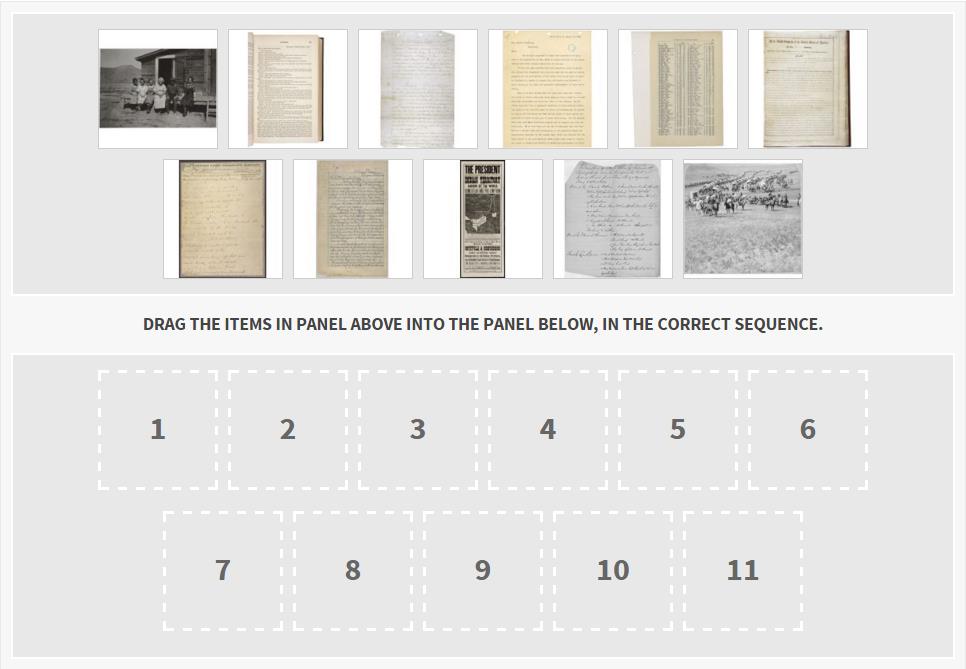
Open the activity as a class. Choose a few documents to look at more closely. Ask if anyone can identify and explain any of the documents without further examination (for example, “Can you tell what kind of document any one is? How do you know?”). Ask for suggestions as to which documents are “earlier” and which are “later.” Students should be able to explain their presumptions. (To bolster students’ confidence and willingness to make informed guesses, remind them that at this point it is entirely appropriate to make a guess with scant evidence because they have not yet done any careful examination.)
Choose one of the documents with which to
model document analysis. Then ask students to synthesize the information they have gathered and answer: “What is this document telling us about this time?” Remind students that they should replicate this close analysis of each document they open before they begin to move any of the documents.
Ask students to sequence the documents as class, individually, or in small groups. When they have finished sequencing, debrief as a class. Ask students to verbalize their answers to the concluding questions. Compare the responses to the debriefing questions/activities with the initially brainstormed list of issues that Native Americans may have faced. Ask students if these issues were resolved and how. Also ask students if they can decipher any official Government policy toward Native Americans in the West.
Choose one document on which to focus to ask students the following:
- How would you have felt in this situation?
- What do you think should have been done?