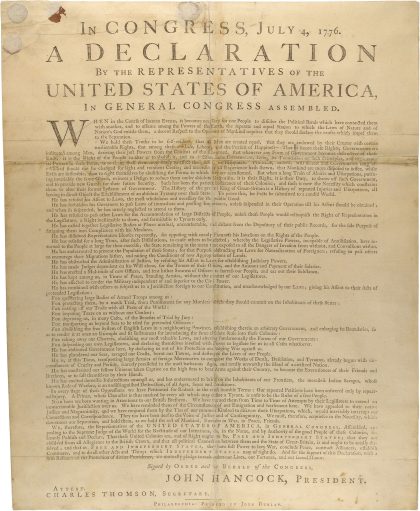
In July 1776, the Second Continental Congress adopted the Declaration of Independence in which the American colonies set forth a list of grievances against the British Crown and declared they were breaking from British rule to form free and independent states.
The Continental Congress had, on June 10, appointed a committee of five to draft a statement of independence for the colonies. The committee included Thomas Jefferson, John Adams, Benjamin Franklin, Robert R. Livingston, and Roger Sherman, with the actual writing delegated to Jefferson.
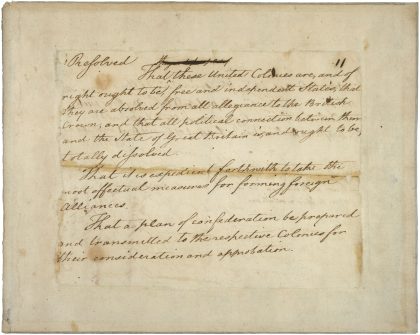
Jefferson drafted the statement between June 11 and 28, submitted drafts to Adams and Franklin who made some changes, and then presented the draft to the Continental Congress following the July 2 adoption of the independence section of the Lee Resolution. The congressional revision process took all of July 3 and most of July 4. Finally, in the afternoon of July 4, the Declaration was adopted.
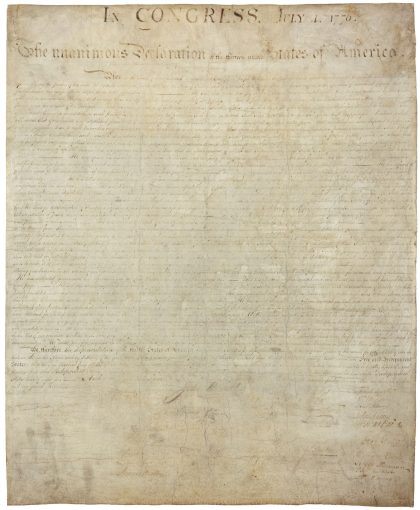
On July 19, Congress resolved that the Declaration be fairly “engrossed” on parchment with a new title, “the unanimous declaration of the thirteen united states of America,” and signed by every member of Congress. Engrossing is the process of copying an official document in a large hand. The engrosser of the Declaration was probably Timothy Matlock, an assistant to Charles Thomson, secretary to the Congress.
Although it bears the date “July 4, 1776,” the engrossed Declaration was signed on August 2, by members of the Continental Congress who were present that day and later by other members of Congress. John Hancock, the President of the Congress, signed the engrossed copy with a bold signature. The other delegates, following custom, signed beginning at the right with the signatures arranged by states from northernmost New Hampshire to southernmost Georgia. Since not all of the delegates were present on August 2, 56 delegates eventually signed the document. Late signers included Elbridge Gerry, Oliver Wolcott, Lewis Morris, Thomas McKean, and Matthew Thornton, who was unable to place his signature with the other New Hampshire delegates due to a lack of space. Some delegates, including Robert R. Livingston of New York, a member of the drafting committee, never signed the Declaration.
The King of England considered members of the Second Continental Congress to be rebels and traitors. Affixing one’s name to this document meant pledging your life, fortune, and your sacred honor to the cause of freedom. While none of the signers of the Declaration of Independence was actually put to death for this act, many suffered consequences during the course of the Revolution. Fifteen of the signers had their homes destroyed; others were punished indirectly, through their wives and children. By the end of the Revolutionary War, more than one-half of the signers suffered physical harm, imprisonment, property destruction, or other penalties for their acts.
Use this page to find primary sources related to the Declaration of Independence and the “big ideas” it contains, as well as document-based learning activities to share with your students.