

WWI Propaganda and Art

Making Connections
Share to Google Classroom
Recommended Activity
Published By:
National Archives Foundation
Historical Era:
The Emergence of Modern America (1890-1930)
Thinking Skill:
Historical Analysis & Interpretation
Bloom’s Taxonomy:
Analyzing
Grade Level:
High School
Suggested Teaching Instructions
Use this activity while teaching about World War One, propaganda, or journalism. Students will discover the nature of WWI propaganda, identify why Army officials might have been frustrated with the artists’ work, and explore the difficulty in accurately documenting wartime events and conditions. The activity also offers an opportunity to discuss the risks posed to civilians who cover wartime as reporters, photographers and artists, and whether educating the public and/or affecting public perception of the war is worth compromising individual safety. For grades 9–12. Approximate time needed is 45 minutes.
Provide students with background information as necessary:
The Committee for Public Information was created by President Woodrow Wilson’s Executive Order in 1917 to influence the American public to support the war effort. (Find more information on the Committee for Public Information and images of some of the artwork on the U.S. Army Center of Military History’s website. Read about the artists employed by the U.S. Government’s Committee for Public Information on the National Archives blog “The Unwritten Record.”)
Direct students to begin the online activity. They will analyze and answer questions about four memos exchanged by AEF General Headquarters (Intelligence, Censorship and Press division), General John J. Pershing (who led the American Expeditionary Forces), and the artists between August and September 1918.
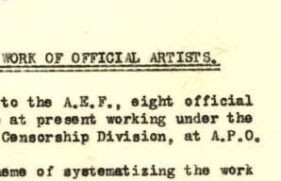
The memos illustrate the challenges facing the group of civilian artists trying to fulfill their wartime mission of capturing the action in the trenches and on the battlefield. Despite a mission with “considerable latitude” and a “schedule of work…as elastic as possible” (from the document “General Policy Reference the Work of Official Artists”), it was not long before the artists were criticized for producing art that served neither “a military purpose nor propaganda purposes” (from the document “Complaint from Major, N.A., to Captain Smith”).
Students will explore what caused the dissatisfaction from the artists’ superiors and what prevented the artists from producing battle scenes and instead creating scenes that “lack action and…human interest” (“Complaint from Major, N.A., to Captain Smith”) and were “unsuitable for publication in the periodical press” (from the document “Cablegram from the Acting Adjutant General”). They will analyze a memo from General Pershing, however, that excused the artists and offered another perspective on the value of their work.
Once students have answered all of the questions presented about the documents, they should click “When You’re Done” to answer follow-up questions in preparation for a class discussion:
- How did the subject of the art change over time?
- What factors explain the change?
- Do you think that civilians should be embedded (assigned to travel with military units) during war? Why or why not?
- How do you think changes in technology have affected how civilians embedded in military units do their jobs documenting or reporting on wars today?

To the extent possible under law, National Archives Foundation has waived all copyright and related or neighboring rights to “WWI Propaganda and Art”
Description
Students will learn about Government propaganda during World War I as they analyze four memos about war art created for this purpose. Artists were employed by the U.S. Government’s Committee for Public Information and followed troops into France with the American Expeditionary Forces (AEF) during the war. Commissioned as officers in the Corps of Engineers, the artists were assigned to create artwork in a variety of media to show the war to Americans back home. As their artwork was sent back to the United States, the Federal Government and military officers criticized some of them for failure to accurately convey the experience of battle.
Share this activity with your students
Documents in this Activity
Complaint from Major, N.A., to Captain Smith
The Emergence of Modern America (1890-1930)

Doughboy Fighting Through Barbed Wire Entanglements
The Emergence of Modern America (1890-1930)
General Policy Reference the Work of Official Artists
The Emergence of Modern America (1890-1930)