

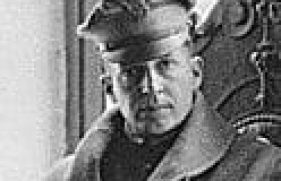
What Kind of Leader Was General Douglas MacArthur?

Weighing the Evidence
Share to Google Classroom

Recommended Activity
Published By:
National Archives Foundation
Historical Era:
Postwar United States (1945 to early 1970s)
Thinking Skill:
Historical Issues-Analysis & Decision-Making
Bloom’s Taxonomy:
Evaluating
Grade Level:
High School
Suggested Teaching Instructions
Use this activity after teaching about the Korean War, to examine the concept of leadership, or to examine the role of the president as commander in chief as stated in the Constitution. Students will identify leadership characteristics, and evaluate MacArthur’s leadership based on primary source evidence. For grades 11-12. Approximate time needed is 90 minutes.
Direct students to familiarize themselves with MacArthur’s personal history and military role. Some helpful resources are:
- MacArthur, Douglas. Reminiscences. New York: McGraw-Hill, 1964
- Manchester, William. American Caesar: McArthur – 1880-1964, New York: Little Brown and Co., 1978
- General Douglas MacArthur Search Results in the National Archives Catalog
- The MacArthur Memorial Website
As a warm-up activity, ask students to think about a person whom they regard as a strong leader. Encourage students to write down four things that make this person a strong leader. Discuss the characteristics with students and create a list of leadership traits.
Review the historical context of the first half of 20th-century American history, including World War I, World War II (Pacific Campaign), and the Korean War. Open the activity, and direct students to read the Introduction. Share with students the following quote from William Manchester’s biography of MacArthur, American Caesar:
He was a great thundering paradox of a man, noble and ignoble, inspiring and outrageous, arrogant and shy, the best of men and the worst of men, the most protean, most ridiculous, and most sublime.” Ask students to define unfamiliar words.
Compare the list of leadership traits they created with this description of MacArthur.
Choose one photograph, written document, or video clip from the list of documents. Model careful document analysis for the class. Divide the class into groups of three to four students, and assign each group three documents to analyze. After they have completed their analysis, ask a representative from each group to share.
Ask each group to consider all of the documents and the list of leadership characteristics. They should come up with two contradicting interpretations about what kind of leader MacArthur was.
For example:
- Interpretation 1 – General Douglas MacArthur was an inspiring leader,
- Interpretation 2 – General Douglas MacArthur was an ineffective leader.
Ask each group to write their interpretations at either end of the scale of the activity, then place each document on the scale based upon how it supports those interpretations. (Or students may wish to place documents on the scale first and then come up with interpretations. For both methods, remind students that they may change their minds about the placement of documents as they go along.)
When students finish, they can see how well the documents support the historical interpretations.
Conduct a class discussion by asking:
- Which documents were placed where? Why?
- Which documents were given greater weight? Why?
- What historical conclusions did you draw about MacArthur?

To the extent possible under law, National Archives Foundation has waived all copyright and related or neighboring rights to “What Kind of Leader Was General Douglas MacArthur?”
Description
In this activity, students will analyze video clips, photographs, and written documents related to General Douglas MacArthur to explore the controversy surrounding his career, especially the decision by President Harry S. Truman to remove him from command during the Korean conflict. Students will use the scale to organize evidence and arrive at their own conclusion about MacArthur.
Share this activity with your students
Documents in this Activity
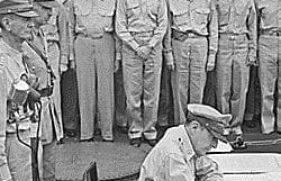
General Douglas MacArthur signs as Supreme Allied Commander during formal surrender ceremonies on the USS MISSOURI in Tokyo Bay. Behind General MacArthur are Lieutenant General Jonathan Wainwright and
The Great Depression and World War II (1929-1945)

General Douglas MacArthur wades ashore during initial landings at Leyte, Philippine Islands
The Great Depression and World War II (1929-1945)

House of Representative remarks on President Harry S. Truman's decision to replace General Douglas MacArthur as Supreme Commander, Allied Powers; Commander in Chief, United Nations Command; Commander
Postwar United States (1945 to early 1970s)