


What Else Was Happening During the Civil War Era? (Stephen Parlow)

Finding a Sequence
Share to Google Classroom
Published By:
Stephen Parlow
Historical Era:
Civil War and Reconstruction (1850-1877)
Thinking Skill:
Chronological Thinking
Bloom’s Taxonomy:
Analyzing
Grade Level:
Middle School, High School
Suggested Teaching Instructions
This activity can be taught before, during, or immediately following a Civil War and Reconstruction unit, including during a unit on Westward Expansion. It can serve as an introduction to other events and changes that were taking place during the Civil War era. For grades 6-12. Approximate time needed is 45 minutes.
Open the activity to reveal the 16 documents in random sequence. Explain that all of the documents were created within the period 1850 to 1877. Using only the document titles (move cursor over document thumbnail) for reference, ask the class to hypothesize which documents are likely to be dated toward the beginning of that period and which are more likely to be later documents. (Students may record their predictions in written format to use for later comparison.)
Open up the first document in chronological sequence — the Compromise of 1850 — to view the document in more detail. Engage in a full-class demonstration of how to analyze a primary source document. Ask students to identify the date and author(s) of the document. Students should read the document details to discover for whom the document was written and why it was created. Use the date of the document, its content, and other resources if necessary to put the aim and impact of Clay’s idea for compromise into plain language.
Once the class has practiced document analysis with the Compromise of 1850, explain that students should give each document they look at the same careful consideration before attempting to sequence the documents. Read and examine each document and put the documents in the correct sequence as a class or in pairs or individually.
When students have sequenced all of the documents, compare their earlier predictions with the correct sequence. Ask a series of questions to debrief the content:
- Were there any surprises?
- What did you learn that you did not previously realize about the period 1850 to 1877?
- Do the events referred to in these documents that do not seem to be directly related to the Civil War relate to that conflict in some indirect way?
- How would you characterize the U.S. Government from 1850 to 1877?
- How would you characterize this period in U.S. history?

To the extent possible under law, Stephen Parlow has waived all copyright and related or neighboring rights to “What Else Was Happening During the Civil War Era? (Stephen Parlow)”
Description
The years leading up to, during, and following the Civil War and Reconstruction (1850-1877) are most often remembered for the tension between North and South, the question of slavery, President Lincoln, and social and political changes in the postwar South. In this activity, students will explore changes that occurred in the United States in the greater context of the Civil War era.
Students will learn about the many, seemingly unrelated events that happened simultaneously during this time period, the multifaceted nature of American government during wartime, and that historical eras are not solely focused on one historical topic.
Share this activity with your students
Documents in this Activity
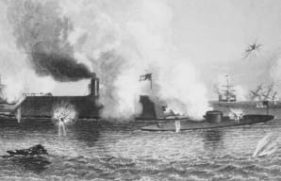
Naval Engagement in Hampton Roads. Merrimac and Monitor. March 1862. Copy of print by J. Davies after C. Parsons
Civil War and Reconstruction (1850-1877)
Homestead Act
Civil War and Reconstruction (1850-1877)
Pacific Railroad Act
Civil War and Reconstruction (1850-1877)