

We Shall Overcome: March on Washington

Zoom/Crop
Share to Google Classroom
Recommended Activity
Published By:
National Archives Foundation
Historical Era:
Postwar United States (1945 to early 1970s)
Thinking Skill:
Historical Analysis & Interpretation
Bloom’s Taxonomy:
Analyzing
Grade Level:
Upper Elementary, Middle School
Suggested Teaching Instructions
This activity can be used as an introduction to the March on Washington during a unit on Civil Rights. It could also be used to illustrate First Amendment rights according to the United States Constitution. For grades 4-8.
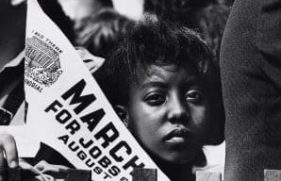
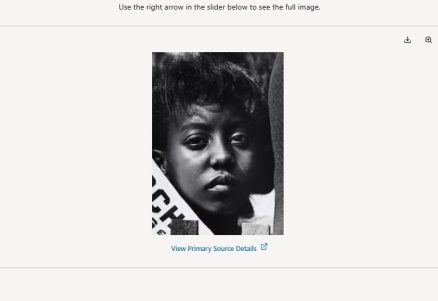
Present the activity to the entire class. Notice that initially, the photograph is cropped to reveal only this young girl’s face. Ask students to describe the photograph and try to determine where this girl might be. Remind students to look at the whole visible area for context clues; even the smallest details may reveal the answer.
Once students have offered some guesses, click on the second thumbnail to reveal the entire document. Then share with students that this young woman is at the March on Washington in 1963.
Clicking on “When You’re Done” will reveal further information:
On August 28, 1963, photographer Rowland Scherman, working for the United States Information Agency (USIA), took this photograph. It has become an iconic image of the March on Washington for Jobs and Freedom.
The girl in the photograph is Edith Lee-Payne of Detroit, Michigan, who celebrated her 12th birthday by attending the March on Washington with her mother. In the photograph she carries a March on Washington banner and concentrates intently on the scene before her.
Ms. Lee-Payne had no idea she had been photographed until her sister saw the photograph in a calendar celebrating African-American history. Students can watch a short video about her and photographer Rowland Scherman on the National Archives YouTube Channel.
As a follow-up, discuss the following questions as a class:
- What does the banner that Edith is holding tell you about the reasons behind the March on Washington?
- Why do you think the organizers of the March chose the Lincoln Memorial as the place to end their march?
- Why do you think it took place in Washington, DC? What impact do you think this had?

To the extent possible under law, National Archives Foundation has waived all copyright and related or neighboring rights to “We Shall Overcome: March on Washington”
Description
In this activity students will use photograph analysis to discover the reasons behind the March on Washington, and think about its significance in the Civil Rights Movement.