

Understanding Perspective: A Letter about Meeting Adolf Hitler

Spotlight
Share to Google Classroom

Recommended Activity
Published By:
National Archives Foundation
Historical Era:
The Great Depression and World War II (1929-1945)
Thinking Skill:
Historical Analysis & Interpretation
Bloom’s Taxonomy:
Analyzing
Grade Level:
Middle School, High School
Suggested Teaching Instructions
This activity may be used to introduce the debate around whether the United States should boycott the 1936 Berlin Olympic Games or reinforce analysis skills by understanding perspective in primary sources. For grades 7-11. Approximate time needed is 30 minutes.
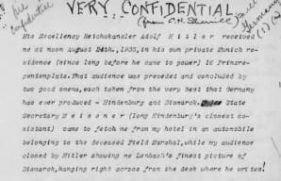
Begin the activity in a full-class setting. Ask students to determine when this letter was made and why the author is writing. Direct students focus to the spotlighted parts of the letter to answer these questions to teach effective document analysis.
Point out the handwritten label “Very Confidential” at the top and ask students to hypothesize why this letter is considered highly sensitive. Does this label match the author’s summary of the letter? Why or why not? Lead students to conclude that the former U.S. ambassador’s visit to Hitler was not an official diplomatic meeting but that it still held political importance.
Explain that the intended recipient was President Franklin D. Roosevelt’s secretary Marguerite LeHand and share details about the public debate surrounding a possible U.S. boycott of the 1936 Olympics. If necessary, provide the following historical context:
In 1935, Mr. C.H. Sherrill, former U.S. ambassador to Turkey and member of the International Olympic Committee’s Executive Board, met with Adolf Hitler to explore whether Germany intended to prevent Jewish athletes from participating in the 1936 Berlin Olympics. Sherrill had been one of three IOC board members to visit Germany in June 1933 to get German assurances that Jewish athletes would be permitted to participate in the Olympic Games.
Upon his return to his home in France, Sherrill wrote to President Franklin D. Roosevelt’s secretary Marguerite LeHand about the meeting, his impressions of Hitler, and his confidence in Hitler’s promise to allow Jewish participation. As a result of this meeting and Hitler’s promise, the IOC voted to hold the games in Germany as planned.
Direct students to click on “View Primary Source Details” to reveal the full document and its details. Working individually or in pairs, ask students to consider the tone of the letter and the author’s word choice. Students should then proceed to answer the discuss questions that follow, which will help guide them through the process of understanding perspective:
- What is Charles H. Sherrill’s purpose for writing this letter? Pay particular attention to the handwritten section at the end. What new information is included there about the 1936 Olympic Games?
- Briefly summarize Sherrill’s overall opinion of Adolf Hitler. What evidence does Sherrill provide to support his opinions about Hitler?
- List details that reveal the creator’s perspective. What clues can you find about their background or point of view?
Once students have worked through the analysis questions and click “When You’re Done,” they will be asked to answer the following in preparation for a class discussion:
- This is one piece of a larger story. What questions do you have that this primary source doesn’t answer?
- What evidence does the creator present that you should “fact check” (verify as true)?
- This primary source shows one perspective on this topic. What other perspectives should you get?
As a class, discuss how understanding perspective can guide our use of primary source documents as historical evidence, explaining that they provide insight into the personal attitudes and motivations that shaped their response to events at that time. Ask students to reflect on their own perspective.
- What did they found out from this document that they might not learn anywhere else?
- How does their background and the time in which they live affect their view of the boycott debate?

To the extent possible under law, National Archives Foundation has waived all copyright and related or neighboring rights to “Understanding Perspective: A Letter about Meeting Adolf Hitler”
Description
In this activity, students will analyze and respond to one person’s impression of German leader Adolf Hitler. Students will use his letter to analyze perspective and consider the ways that personal bias can shape one’s response to people and events.