

Tinker v. Des Moines: Freedom of Speech in the Schoolhouse

Compare and Contrast
Share to Google Classroom
Recommended Activity
Published By:
National Archives Foundation
Historical Era:
Postwar United States (1945 to early 1970s)
Thinking Skill:
Historical Analysis & Interpretation
Bloom’s Taxonomy:
Analyzing
Grade Level:
Middle School
Suggested Teaching Instructions
This activity can be used in units about the Vietnam War, civil liberties, or a civics lesson about the Declaration of Independence or the Bill of Rights. For grades 6-8. Approximate time needed is 45 minutes.
As a warm-up exercise, ask students to define freedom of speech and to give examples of this civil liberty. Remind students that freedom of speech, the ability to express an opinion or idea without government restrictions or punishment, is guaranteed under the First Amendment of the Bill of Rights. Next, ask students to define symbolic speech and to give examples. Explain to students that symbolic speech is a form of nonverbal or nonwritten communication that expresses an opinion (e.g., marching, wearing an arm band). Symbolic speech is protected under the First Amendment right to freedom of speech.
Explain to students that they will be comparing two primary source documents that highlight some of the context and arguments central to the Tinker v. Des Moines Supreme Court case–a case that involved public school students exercising their First Amendment right to symbolic speech.
In preparation for the main activity, share the following historical context, if needed:
In Tinker v. Des Moines, the Supreme Court ruled that public schools cannot restrict students’ First Amendment rights to freedom of speech and expression without demonstrating that exercising these rights would cause a “material and substantial interference with schoolwork or discipline.” In other words, students take their First Amendment rights with them into the classroom.
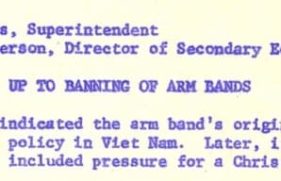
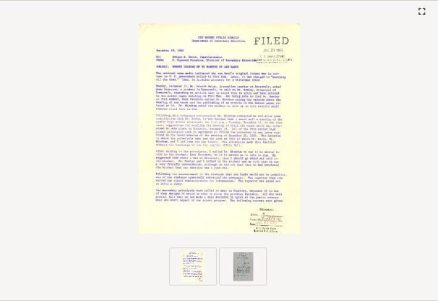
Direct students to begin the main activity, which can be done individually or in pairs. Students will be instructed to look closely at the two documents presented: John Tinker’s testimony to the 8th Circuit Court of Appeals and a memorandum from the Des Moines Public Schools’ director of secondary education about the arm band demonstration. Remind them to click on “View Entire Document” to see all pages of the documents and to access additional background information.
Students should answer the questions below the documents:
- What reasons did John Tinker give for wearing the black arm band to school? What reasons did the senior high school principals give to support the policy against wearing arm bands?
- How is the description of events surrounding the arm band protest similar and different between the two documents? Why do you think these differences exist?
When they have finished analyzing each document, students should click on “When You’re Done” where they will be presented with the the following questions to consider in preparation for a class discussion:
- Which arguments given for and against the policy on arm bands did you find the most convincing? Explain why.
- Should public schools have the authority to limit students’ freedom of speech to maintain order and protect learning? Why or why not?
If needed, as a part of the activity, provide students with the following historical context:
In 1965, several junior high and high school students decided to wear black arm bands from December 16 until New Year’s Day to peacefully express their “grief over the deaths of soldiers and civilians in Vietnam.” On December 14, Des Moines School District principals met and enacted a rule that “any student wearing an arm band would be asked to remove the arm band, and if he refused he would be suspended until he returned without the arm band.” The policy was announced to all students on December 15, as well as reported in The Des Moines Register.
Students Mary Beth Tinker, John Tinker, Christopher Eckhardt, and two others were suspended after refusing to remove their black arm bands when they arrived at school on December 16th and 17th. Upon their suspensions, the Tinkers and Eckhardt refused to return to school until after New Year’s Day – the intended period for wearing the arm bands.
With assistance from the American Civil Liberties Union (ACLU), the Tinker and Eckhardt families filed a complaint against the school district for violation of the right to free speech under the First Amendment. They further argued that First Amendment rights are protected from state infringement (such as a public school board) under the due process clause in the Fourteenth Amendment. The U.S. District Court dismissed the case, agreeing with the school district’s actions, based on their claim that the arm bands would have caused a disruption at the school. After the U.S. Court of Appeals for the 8th Circuit split evenly over the decision, thus upholding the District Court decision by default, the Tinkers and Eckhardts appealed their case to the Supreme Court.
In the landmark 1969 Tinker v. Des Moines decision, the Supreme Court ruled in favor of the plaintiffs, the Tinkers and Eckhardts. In the opinion, written by Justice Abe Fortas, the Court stated “[The wearing of arm bands] was closely akin to ‘pure speech’ which, we have repeatedly held, is entitled to comprehensive protection under the First Amendment.” Further, “It can hardly be argued that either students or teachers shed their constitutional rights to freedom of speech or expression at the schoolhouse gate.”
Connection to the Declaration of Independence/Bill of Rights: If using this activity as part of a broader civics lesson, explain to students that the Declaration of Independence proclaims that the rights of “life, liberty, and the pursuit of happiness” are unalienable, meaning that they cannot be taken away. Building upon this principle, the Bill of Rights, the first ten amendments to the Constitution, protects individual rights and limits the government’s power. One of these liberties is freedom of speech (First Amendment). The documents included in this activity reveal some of the context and arguments behind the Tinker v. Des Moines case in which the Supreme Court argued that neither public school students nor teachers lose their First Amendment right to freedom of speech at the “schoolhouse gate.”
For additional materials related to Tinker v. Des Moines: Freedom of Speech in the Schoolhouse (including Guiding Questions, National Standards, Historical Background and Supplemental Educational Resources).

To the extent possible under law, National Archives Foundation has waived all copyright and related or neighboring rights to “Tinker v. Des Moines: Freedom of Speech in the Schoolhouse”
Description
In this activity, students will carefully analyze primary sources to investigate the context and arguments behind the landmark Tinker v. Des Moines Supreme Court case.
Share this activity with your students
Documents in this Activity

Testimony of John Tinker in Tinker v. Des Moines
Postwar United States (1945 to early 1970s)