

The Three Branches of Government

Mapping History
Share to Google Classroom

Recommended Activity
Published By:
National Archives Foundation
Historical Era:
Across Eras: Civics & Government
Thinking Skill:
Historical Analysis & Interpretation
Bloom’s Taxonomy:
Analyzing
Grade Level:
Upper Elementary
Suggested Teaching Instructions
This activity can be used while studying the U.S. Government and Constitution. It can be shared with students as an introduction to, or review of, the three branches of government. For grades 3–5. Approximate time needed is 30–45 minutes.
Instructions
Share the United States Constitution with students. Explain that the Constitution describes how the government is structured and how it operates. The Constitution is broken up into different parts called articles, and the first three articles set up the three branches of government and their powers – the legislative branch, the executive branch, and the judicial branch:
- All legislative Powers herein granted shall be vested in a Congress of the United States, which shall consist of a Senate and House of Representatives. (Article 1)
- The executive Power shall be vested in a President of the United States of America (Article 2)
- The judicial Power of the United States, shall be vested in one supreme Court (Article 3)
The President, Congress, and the Supreme Court are all located in Washington, DC, the nation’s capital. Each branch of government has different characteristics and different jobs to do, but sometimes these jobs overlap.
Inform students that, as a class, they will be working together to analyze different documents and match each document to its corresponding branch or branches.
Choose one document or photograph as an example and click orange “open in new window” icon in the lower right corner to examine the full image. Model careful document analysis for students to figure out what is happening. If the document connects to more than one branch, show how the document icon can be placed on the Venn diagram to reflect this. As students examine the written documents, they should focus on scanning for key words related to the different branches as opposed to reading entire documents.
Possible Modifications:
- This activity can also utilize small group work. Students can work in small groups to place the documents and then report back in a full-group discussion. Student groups may place the documents in different sections of the Venn diagram and this could lead to a full-class debate.
- This activity asks students to match 13 different documents. This activity can be shortened by analyzing and placing a reduced number of documents. The documents are organized by exterior building photographs, interior photographs of people, political cartoon representations, and government documents.
Answer Key and Additional Explanations
The following can be used as a reference as students examine and place the documents:
Legislative Branch
- Photo – United States Capitol: This is where Congress works.
- Political Cartoon – Vote on Military Bonus Bill: This cartoon depicts Uncle Sam and a Teddy Bear tallying aye and no votes coming out of the Capitol building as Congress votes on a new bill (proposed law).
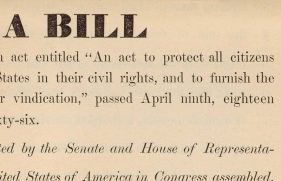
- Document – Sumner Civil Rights Bill: This is an example of a bill (proposed law) from the Senate. A bill does not become a law until it is passed by Congress and signed by the President. (This touches upon the Judicial Branch as well since the U.S. Supreme Court ruled the Civil Rights Act of 1875, which resulted from this bill after it was debated and revised, unconstitutional.)
Executive Branch
- Photo – Exterior of The White House: This is where the President lives and works.
- Photo – President Barack Obama Talks with Vice President Joe Biden in the Oval Office: This is the President’s office in the White House. The Executive Branch includes the Vice President.
- Document – Executive Order 10924: Part of the President’s job includes making Executive Orders. These actions come straight from the President.
Judicial Branch
- Photo – Supreme Court Building: This is where the Supreme Court works.
- Political Cartoon – The Supreme Court Returns To Its Permanent Home: This cartoon shows the Supreme Court Justices walking into the Supreme Court Building.
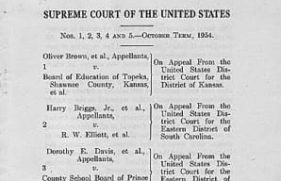
- Document – Opinion of the Supreme Court of the United States: This is an example of a Supreme Court case. The Supreme Court can decide if laws are in line with the Constitution.
Legislative and Executive Branches
- Political Cartoon – Anyone Home?: This cartoon shows a proposed law that has been passed by Congress on its way to the White House for the President’s approval. Congress and the President share the power to pass laws.
Executive and Judicial Branch
- Photo – Supreme Court Justices Pose with President Ronald Reagan in The Supreme Court Conference Room: This photo could be sorted as the Judicial Branch, as it was taken in the Supreme Court building and features the Supreme Court Justices. However, the President is also included in this photograph.
Legislative, Executive, and Judicial Branches
- Photo – President Bush’s State of the Union Speech: This photo could be sorted as a Legislative Branch photo, as it does show the interior of the Capitol. However, if you look closely, you can find members of Congress, the Supreme Court, and the President meeting for the President’s yearly State of the Union speech.
- Document – Nomination of Sandra Day O’Connor as Supreme Court Justice: This document includes all three branches. The President has the power to chose Supreme Court justices, but the Senate has to approve the President’s choice.
When You’re Done
When students have finished sorting the documents and click on “When You’re Done,” they should consider the following questions presented to them:
The Constitution creates three branches of government with separate powers (powers just for that branch) and shared powers (responsibilities that more than one branch shares). Why do you think the writers of the Constitution decided to create this type of system?
In this activity, you reviewed just a few of the job details of the three branches of government. Can you think of additional characteristics or responsibilities for each branch?
Finally, can you locate the three buildings for the three different branches on this map of the Washington DC?

To the extent possible under law, National Archives Foundation has waived all copyright and related or neighboring rights to “The Three Branches of Government”
Description
In this activity, students will use a Venn diagram to match primary source documents and photographs representing various functions of the government to their corresponding branch (or branches) of government.
Share this activity with your students
Documents in this Activity
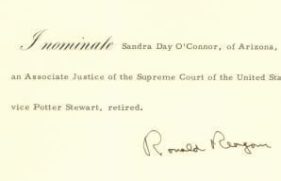
Nomination of Sandra Day O'Connor as Supreme Court Justice
Contemporary United States (1968 to the present)

Executive Order 10924 Establishing the Peace Corps
Postwar United States (1945 to early 1970s)