

The Suffrage and the Civil Rights Reform Movements

Compare and Contrast
Share to Google Classroom
Recommended Activity
Published By:
National Archives Foundation
Historical Era:
Across Historical Eras
Thinking Skill:
Historical Analysis & Interpretation
Bloom’s Taxonomy:
Analyzing
Grade Level:
Middle School, High School
Suggested Teaching Instructions
This activity is intended as a warm-up or introduction to a study of reform movements, or for use when studying women’s suffrage (also known as “woman suffrage”) or the Civil Rights movement. For grades 6-12. Approximate time needed is 15-20 minutes.
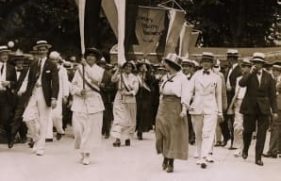
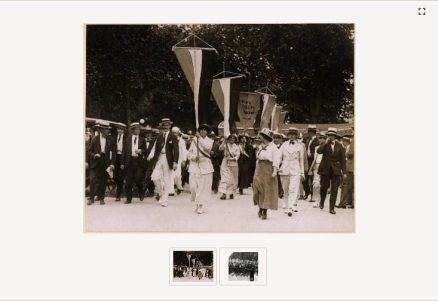
Present the activity to the entire class. Model careful analysis with students. Ask one half of the class to focus on one photograph, and the other half to tackle the other. Remind them to use the blue buttons at the bottom of the photographs to look more closely at each one.
Students will be instructed to create a list of the people, objects, and activities in each photograph.
Note: For the list of people, ask students to look at the types of people, specific famous people, and any other details about the people in the photographs (e.g. size of group, clothing, ethnicities, etc).
Bring the class back together and ask students to report on each individual photograph as you list the people, objects, and activities for the entire class to see.
After this discussion, have students pair off and discuss similarities and differences between the photographs in a small group. Next, discuss the similarities and differences between these photographs together as a class.
Some of the similarities they may notice include:
- Both groups are protesting in the nation’s capital.
- Both groups are using banners and slogans to spread their message.
- Both groups appear peaceful and well mannered.
Some of the differences they may notice include:
- In the suffragist photo, men do not seem to be a part of the marchers (instead, merely spectators). Civil Rights marchers includes both men and women, as well as African Americans and Whites.
- Suffragist marchers seem to be a smaller group.
- The original caption of the suffragist photograph (“Bastille Day spells prison for sixteen suffragettes who picketed the White House”), seen if students click on View Entire Document, explains a negative reaction to their march: prison.
- The slogans of the Civil Rights group seem more focused on particular goals (segregation, voting rights, jobs), while the suffragist banner uses a slogan of the French Revolution (Liberty, Equality, and Fraternity).
- There are more recognizable faces and names in the Civil Rights photograph (Martin Luther King, Jr., for example)
Finally, ask students to respond to the conclusion questions they see after clicking “When You’re Done”:
- Based on your observations of similarities and differences, do these two photographs explain differences between the women’s suffrage and Civil Rights movements?
- If so, what are the differences?
- What do you think was the biggest and most important difference between these two movements? Citing specific evidence from the primary sources, explain your opinion.
Extension Activity: Direct students to explore additional photographs of the women’s suffrage movement and photographs of the March on Washington for Jobs and Freedom.

To the extent possible under law, National Archives Foundation has waived all copyright and related or neighboring rights to “The Suffrage and the Civil Rights Reform Movements”
Description
This short comparative analysis activity involves comparing and contrasting two images of marches for freedom: a 1917 Bastille Day march for women’s suffrage, and the 1963 March on Washington for Jobs and Freedom. Students will consider the similarities and differences between these two images and hypothesize what major differences these photos might imply about the two social reform movements.
Share this activity with your students
Documents in this Activity

Photograph of Leaders at the Head of the Civil Rights March on Washington, D.C.
Postwar United States (1945 to early 1970s)