

The National Women’s Conference of 1977

Making Connections
Share to Google Classroom
Recommended Activity
Published By:
National Archives Foundation
Historical Era:
Contemporary United States (1968 to the present)
Thinking Skill:
Historical Comprehension
Bloom’s Taxonomy:
Understanding
Grade Level:
Middle School, High School
Suggested Teaching Instructions
This activity can be used during a unit on the Equal Rights Amendment, women’s rights, second-wave feminism, and the 1970s. For grades 6-12. Approximate time needed is 60 minutes.
To begin, select one of the first photographs in the activity and model document analysis for the full class. Next, ask students to work in small groups or individually to complete the activity. They should first quickly scan all of the photographs in the activity. Then they should choose four for deeper analysis.
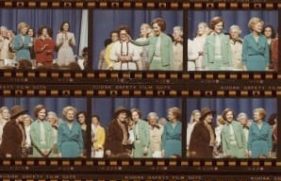
Note: Explain to students that several of the items included are contact sheets of the photographic negatives that include a variety of images–students should choose at least one of those groupings to analyze as well.
For the photographs that students choose to analyze, tell them to respond to the following in the blank box after each photo:
- Quickly scan the photo. What do you notice first?
- List the people, objects and activities you see.
- Write one sentence summarizing this photo.
After they have completed analysis of four photographs individually or in small groups, place students in small groups (or new groups) to compare and contrast their findings. Once they are familiar with each other’s photographs, ask them to compile a list of adjectives that they think describe the National Women’s Conference of 1977.
Ask students to discuss these adjectives in their small groups. For specific adjectives, prompt students to explain their word choices with specific evidence observed from the photographs. Bring the class back together and discuss their adjectives, posting them for the entire class to see.
After discussing their observations from the photographs, ask students:
- What conclusions can you draw about the National Women’s Conference? What was happening at the time in history these photos were taken?
- What did you find out from these photos that you might not learn anywhere else?
- What other documents, photos, or historical evidence could you use to help you understand this event or topic further?
Share the following historical context, if necessary:
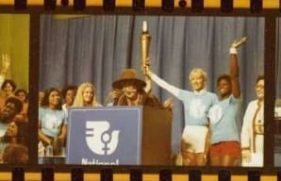
More than 20,000 people—including First Lady Rosalynn Carter, former First Ladies Lady Bird Johnson and Betty Ford, Coretta Scott King, and Susan B. Anthony II (the suffragist’s grandniece)—attended the First National Women’s Conference in Houston, Texas, in 1977. The torch was passed to a new wave of women reformers at the ambitious conference. Over 2,000 delegates recommended to Congress and the President how to advance women’s rights. Delegates adopted a 26-plank national plan, addressing issues such as career interests, rights for minority women, and the Equal Rights Amendment. The outcome was a National Plan of Action for women’s rights, inclusive of women of color.
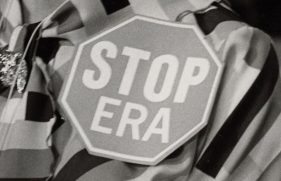
The conference adopted resolutions furthering reproductive freedom and equality for gay women, marking the culmination of the radical feminist movement. The planks for sexual freedom elicited conflicting emotions as a rising conservative faction took particular issue with abortion and “lesbianism.” While these conservative women were the minority at the conference, their “pro-family” movement gained political power throughout the 1980s.
Ratification of the the Equal Rights Amendment (ERA) was also a major goal of the National Women’s Conference. First introduced in 1923 by Susan B. Anthony’s nephew, Congressman Daniel R. Anthony, and drafted by Alice Paul and Crystal Eastman, leaders in the fight for women’s rights, the ERA was introduced in Congress as a way to end discrimination against women.This amendment was reintroduced at every subsequent session of Congress for 49 years. Supporters believed it would provide full equality for women; opponents considered it unnecessary, and some believed it destructive of the family.
In 1972 the amendment passed both houses of Congress. In 1978, with the deadline fast approaching, and the ERA lacking the required number of state ratifications, Congress extended the time limit to June 30, 1982 (viewed as a major achievement of the National Women’s Conference). However, by the time the extended deadline arrived, the ERA had only been ratified by 35 states – three states short of the three-fourths required for ratification of constitutional amendments.

To the extent possible under law, National Archives Foundation has waived all copyright and related or neighboring rights to “The National Women’s Conference of 1977”
Description
In this activity, students will analyze a series of photographs taken during the National Women’s Conference held in Houston, Texas in November 1977.
Share this activity with your students
Documents in this Activity

National Women's Conference Photographs
Contemporary United States (1968 to the present)
National Women's Conference Photographs
Contemporary United States (1968 to the present)
Woman Wearing a "Stop ERA" Badge
Contemporary United States (1968 to the present)

