

The Legislative Process: Congress at Work

Finding a Sequence
Share to Google Classroom
Recommended Activity
Published By:
National Archives Foundation
Historical Era:
Across Eras: Civics & Government
Thinking Skill:
Historical Research Capabilities
Bloom’s Taxonomy:
Analyzing
Grade Level:
Middle School, High School
Suggested Teaching Instructions
This activity is recommended for students in grades 7-12. It is suitable for students in Civics or U.S. Government courses. The time required is approximately 45 minutes. It may be done individually or in student pairs.
Objective: Students will be able to answer the Guiding Question: How does Congress make laws?
1. Introduce the Legislative Process and Document Analysis Introduce or review the steps of the legislative process with students. Refer to the the document analysis page for guidance on learning with primary source documents.
2. Legislative Process in Action This activity introduces students to the central action of representative government by engaging them in analyzing a model sequence of lawmaking. In practice, the legislative process can be abbreviated or more complex; this lesson introduces the 10 elemental steps that demonstrate how Congress acts. Before it becomes law, a bill must pass both the House of Representatives and the Senate. These distinct institutions have different rules and unique traditions which slightly alter the process. However, the 10 steps described here are common to both chambers.
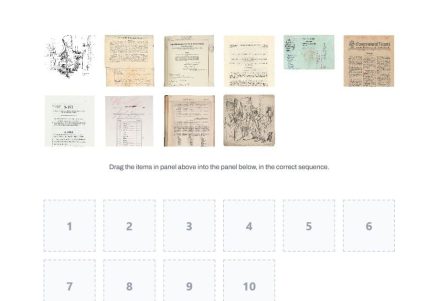
Students will work individually or in pairs to match the 10 steps to 10 primary source documents. As they analyze documents, students will arrange them in the order that they were created during the legislative process.
Note: The documents in this activity are not in chronological order. Nor are they related to one house of Congress or one specific bill; rather, they span more than 200 years of congressional history.
Students should analyze each document to determine during which of the 10 steps it was created. When students click on Show Hints, they will see the name of each step inside the box to which they should drag the appropriate document. The document details have been disabled for this activity so that the document titles do not give away the answers to the students.
The 10 steps:
- Desire for legislation is voiced
- Bill is introduced and referred to committee
- Committee collects testimony and information
- Committee reports to full chamber
- Floor debate
- Vote on bill
- Process is repeated in other chamber
- House and Senate bills are reconciled in a conference
- Act sent to President
- President signs act
3. Reflect on the Process After students have placed the 10 documents in the correct order, they should click “When You’re Done” and answer the questions:
- Which document best illustrates citizens participating in the legislative process? Why did you choose it?
- Which documents show multiple perspectives being voiced? Whose voices do you see?
- At which step of the process can elected officials best represent the interests of their constituents? Why?
4. Class Discussion Conduct a class discussion about the nature of the legislative process and the role of members of Congress in creating new laws:
- About 3-6% of bills introduced in Congress become law. Is this good or bad? Why?
- Members of Congress know that a bill they introduce has a very small chance of passing. Why do they do it anyway? What purpose is served by introducing a bill?
- How does the legislative process enable the House and Senate to test ideas before they become law?
- How does the process by which legislation is made affect its outcome?
- What do the documents studied in this lesson show about how citizens can affect the legislative process?
- What do you think the public does not know but should learn about how Congress works?
- What features of the legislative process do you think should be preserved? What features should be changed?
- In what way does understanding the legislative process factor into voters’ opinions in favor of or against incumbent candidates?

To the extent possible under law, National Archives Foundation has waived all copyright and related or neighboring rights to “The Legislative Process: Congress at Work”
Description
Students will analyze historical records of the House and Senate to understand the sequence of steps in the legislative process. The students will work collaboratively to study documents and identify the step in the process that each illustrates. Discussion questions will engage students in reflecting on how the process of legislation enables Congress to fulfill its constitutional role of representing the American people.
Share this activity with your students
Documents in this Activity
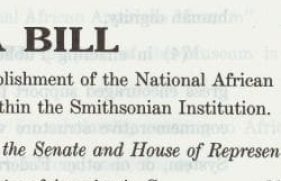
S. 277, a Bill to Authorize the Establishment of the National African American Museum within the Smithsonian Institution
Contemporary United States (1968 to the present)

Minutes of the House Committee on Interstate and Foreign Commerce
Postwar United States (1945 to early 1970s)
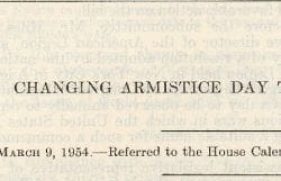
H. Rpt 1333, Report on Changing Armistice Day to Veterans Day
Postwar United States (1945 to early 1970s)