


The Chinese Village Exhibit at the 1899 Export Exposition

Making Connections
Share to Google Classroom
Recommended Activity
Published By:
National Archives Foundation
Historical Era:
The Development of the Industrial United States (1870-1900)
Thinking Skill:
Historical Analysis & Interpretation
Bloom’s Taxonomy:
Evaluating
Grade Level:
High School
Suggested Teaching Instructions
Use this activity during a unit on immigration and the Chinese Exclusion Act, imperialism, or while teaching the history of anthropology, “otherness,” and living ethnological displays. For grades 8-12. Approximate time needed is 40 minutes.
Background information: Share the following background information with students before beginning the activity.
Chinese Exclusion Act: The Chinese Exclusion Act was a law passed in 1882 that excluded Chinese laborers from immigrating to the United States. Initially, these restrictions on immigration were only valid for 10 years, but they were extended multiple times. Even after its repeal in 1943, a strict “quota” system effectively banned Chinese immigration until the 1965 Immigration Act struck it down. The Chinese Exclusion Act was the first to exclude potential immigrants primarily because of their nationality, a clear example of anti-Chinese racism in Federal law. These laws did not just exclude potential immigrants — even U.S. born Chinese citizens were required to obtain special permission and certification to return to the United States after traveling abroad.
Living Exhibits and Chinese Village in the 1899 Export Exposition: The Chinese Exclusion Act occurred at a time when the United States and other mostly Western countries were using their power to conquer and control other societies around the world. This is known as imperialism – when a country exerts its power and influence over other countries or territories through diplomacy or military force. An extension of imperialism was the practice of living exhibits (also known as human zoos), in which non-Western peoples were displayed as proof of their “otherness” and of Western civilization’s superiority.
Such an exhibit occurred at the 1899 Export Exposition in Philadelphia, in which Chinese laborers of varying occupations were imported for the purpose of being exhibited as part of a replica “Chinese Village” for the entertainment of fair-goers. Because of the Chinese Exclusion Act, those performers had to get special permission to enter the country. The documents in this activity are the identification papers of Lee Tso, Louis Wai, and Ah Chue – all people who were “on exhibit” at the fair.
Explain to students that one challenge of these documents is that we know very little about the lives of the people who were part of this exhibit. So, students will explore what can be revealed just by the process of asking questions about a set of documents.
Organize groups: Put students in small groups (3-4 students if possible) to begin the activity.
Generate questions: Model careful document analysis. Instruct students to examine the three documents and, as a group, to create a list of as many questions as they can, numbering the questions as they go. Tell students not stop to judge or try to answer the questions, and to record them exactly as stated by the members of their group. In addition, they should make sure to change any statements into questions.
Refining and prioritizing questions: Tell students that, as they generate questions, they should work together to identify each one as an open-ended or close-ended, by putting an O or a C next to each question. If necessary, provide students with definitions and examples of open-ended and close-ended questions. After several minutes, direct each group to pick their top 3-4 questions to share out loud with the rest of the class.
Sharing and discussion: Ask each group to share out their questions while you record them somewhere the entire class can see. Facilitate a class discussion using these questions as a jumping off point. Again, the purpose of sharing these questions is not to answer them, but to explore asking questions as a way of interacting with a text.
If you need additional questions to center your discussion, consider the following:
- What are the strengths and weaknesses of these documents as sources of information about the Chinese Village at the Export Exposition?
- What can we know from studying these documents?
- What kinds of information are missing? What kinds of sources would you consult to try to fill in these gaps?
Assignment: Ask students to return to the activity and click on “When You’re Done.” They should respond to the writing prompt:
- If you could interview Lee Tso, Louis Wai, or Ah Chue about their experiences, what would you ask them? Write a letter to one of these people including your questions and referring to specific details in the documents.

To the extent possible under law, National Archives Foundation has waived all copyright and related or neighboring rights to “The Chinese Village Exhibit at the 1899 Export Exposition”
Description
In this activity students will consider the experiences of several Chinese people who were exhibited in an ethnographic display at the 1899 National Export Exposition.
Share this activity with your students
Documents in this Activity
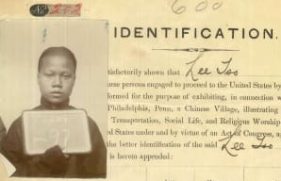
Identification Paper of Lee Tso
The Emergence of Modern America (1890-1930)
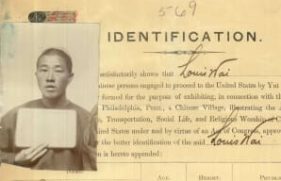
Identification Paper of Louis Wai
The Emergence of Modern America (1890-1930)