

The 1936 Olympics and the Boycott Movement

Weighing the Evidence
Share to Google Classroom
Recommended Activity
Published By:
National Archives Foundation
Historical Era:
The Great Depression and World War II (1929-1945)
Thinking Skill:
Historical Analysis & Interpretation
Bloom’s Taxonomy:
Analyzing
Grade Level:
High School
Suggested Teaching Instructions
This activity may be used to in a US or World History course studying Nazi Germany, World War II and the Holocaust. Students should have some prior knowledge of the election of Adolf Hitler and the Nazi regime, laws enacted by the government to persecute Jews, and the government’s use of propaganda to hide its anti-Jewish policies. The activity can be completed as a class, in small groups, in pairs, or individually. For grades 9-12. Approximate time needed is 60 minutes.
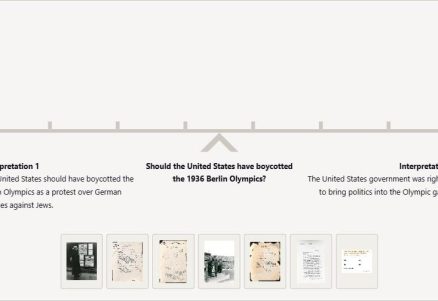
Open the activity and select one of the documents. Model careful document analysis. Demonstrate how the scale works and instruct students to place the records they review on the scale according to the interpretation it best supports: either the United States should have boycotted the Berlin Olympics as a protest over German policies against Jews, or the United States government was right not to bring politics into the Olympic games.
Explain to the students that they will need to place each photograph and textual record on the scale based on careful document analysis. Students do not need to read all pages in a document. For example, for the document “Correspondence from George Messersmith to Secretary of State Cordell Hull about 1936 Olympics 11/15/1935,” only pages 1-3 are important to the activity.
Share the following historical context, if necessary:
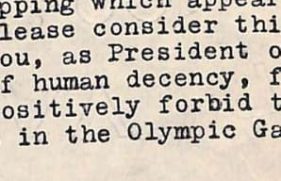
The prospect of holding the 1936 Summer Olympic games in Berlin under the Nazi regime divided athletes, Olympic organizers, and the general public. Between 1933 and the start of the games in 1936, members of the Olympic community voiced concerns about the safety of Jewish athletes, both German Jews and Jewish athletes from abroad, the removal of Jewish athletes from German training facilities, and anti-Jewish legislation.
Some argued that going forward with the games would show support for Adolf Hitler and the Nazi government, whose policies of discrimination they argued were against the Olympic ideal. Others argued that boycotting the games would deprive athletes of the opportunity to represent their country and compete for a medal and record in their sport.
These discussions took place in the American press, in public meetings of the American Olympic organizations, and in private correspondence between the Olympic organizers. Little was said publicly by United States government officials, though much discussion took place behind public view. American diplomats stationed in Germany and Austria continually apprised the State Department of conditions on the ground as Jews in Germany were discriminated against, threatened and attacked, and by 1935 had their citizenship rights revoked. George Messersmith, Consul General in Berlin and later Minister to Austria, wrote to Secretary of State Cordell Hull in 1935.
In this memo (included in this activity) he reported that the German government was using sports as a propaganda tool, “an instrument of the Party for the shaping of youth into National Socialist ideology….Sport has therefore become a political matter.” (page 4). Ambassador William Dodd reported to Cordell Hull at the conclusion of the Olympic games on August 19, 1936, “It is no exaggeration to say…that the Jewish population awaits with fear and trembling the termination of the Olympic period which has vouchsafed them a certain respite against molestation.”
Neither Secretary of State Hull nor President Franklin D. Roosevelt made any comments on whether the United States should support a boycott of the games by American Olympic organizations.
After students complete the activity, they should click on the “When You’re Done” tab and answer the questions listed. Conduct a class discussion based on the students’ answers.
- Do you agree with the Roosevelt administration that U.S. participation in the Olympic Games has no connection to politics? Or is a country’s participation in another country’s event an implicit endorsement of their internal politics? Explain.

To the extent possible under law, National Archives Foundation has waived all copyright and related or neighboring rights to “The 1936 Olympics and the Boycott Movement”
Description
In this activity students will analyze documents and photographs related to the debate over U.S. participation in the 1936 Berlin Olympics. Students will determine what views were held by the United States government as well as American Olympic leaders on a proposed U.S. boycott. They will determine whether or not the US should have boycotted the Berlin Olympics, and they will support their decision by placing on the scale records that support their decision.
Share this activity with your students
Documents in this Activity
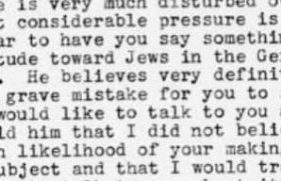
Letter from Samuel Rosenman to President Franklin Roosevelt about C.H. Sherill
The Great Depression and World War II (1929-1945)