

Search Warrants and the 4th Amendment

Spotlight
Share to Google Classroom
Recommended Activity
Published By:
National Archives Foundation
Historical Era:
Across Eras: Civics & Government
Thinking Skill:
Historical Analysis & Interpretation
Bloom’s Taxonomy:
Analyzing
Grade Level:
Middle School
Suggested Teaching Instructions
Use this activity during a unit of study on the Bill of Rights, the United States Constitution or privacy rights. It may be used to introduce the exclusionary rule and reinforce the study of the Fourth Amendment and privacy rights, and is most appropriate after studying the landmark Supreme Court case Weeks v. the United States that established the exclusionary rule. For grades 7–11. Approximate time needed is 10 minutes.
Begin the activity by providing students with the text of the Fourth Amendment. Ask them to determine what the requirements are for issuing a search warrant. Review with students the text of the Fourth Amendment that states, “No warrants shall issue, but upon probable cause, supported by oath of affirmation, and particularly describing the place to be searched and the persons or things to be seized.”
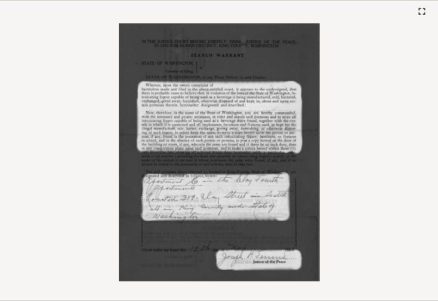
After discussing the Amendment, provide students with the link to the activity and ask them to focus on the spotlighted parts of the document and to respond to the following questions:
- What information is offered as probable cause?
- What is the place to be searched?
- What items are to be seized according to the search warrant?
- Who is the official authorizing the search?
Remind students that they may click on “View Primary Source Details” to reveal the full document and its details.
Ask students if the search warrant fulfills all necessary requirements as outlined in the Fourth Amendment to the Constitution. Hold a class discussion, allowing students to share their responses.
After the discussion, instruct them to click the “When You’re Done” button. Inform them that they will draft a search warrant that would have made the search of Freemont Weeks’ apartment valid. Ask them to consider the items seized by law enforcement when Weeks was arrested, the subsequent search of his apartment and the charges that were filed against him at the time of his trial. This may be completed in class or assigned as homework depending on the length of the class period.

To the extent possible under law, National Archives Foundation has waived all copyright and related or neighboring rights to “Search Warrants and the 4th Amendment”
Description
In this activity, students will analyze a search warrant that was issued during the Prohibition era to determine if it fulfills all of the necessary requirements outlined in the Fourth Amendment of the United States Constitution. Students will later write a search warrant that would have made the evidence seized in the case of Weeks v. United States admissible in court.