

School Integration: The Little Rock Crisis

Compare and Contrast
Share to Google Classroom
Recommended Activity
Published By:
National Archives Foundation
Historical Era:
Postwar United States (1945 to early 1970s)
Thinking Skill:
Historical Analysis & Interpretation
Bloom’s Taxonomy:
Analyzing
Grade Level:
Middle School
Suggested Teaching Instructions
This activity can be used in units about the Civil Rights Movement, or a civic lesson about the Declaration of Independence. For grades 6-8. Approximate time needed is 45 minutes.
As a warm-up exercise, ask students to compare and contrast two images taken of Virginia public schools in 1948: one from a school open to White children only, and the other from a school for Black children. Potential discussion questions include:
- What objects (things) do you see?
- Which area of the school do you think is shown in the photograph? Why do you think this?
- What similarities and differences do you notice between the photographs?
Then, discuss the following background information with students.
The first image, View of the Boys Bathroom at Gloucester Training School, shows the boys bathroom stall at the Gloucester Training High School (the school for Black students). It’s a single stall located outside with no running water. The second image, View of the Girls Bathroom at Botetourt High School, shows a girls bathroom at Botetourt High School (the school for White students) with at least five private indoor stalls, a small vanity mirror, and running water.
Explain to students that these photographs demonstrate the unequal conditions of segregated public schools. Though these schools were, in theory, meant to be “separate but equal” education facilities, Botetourt had central heating, central plumbing, and smaller class sizes. Gloucester Training School had outdoor bathrooms, no central heat, and overcrowded classrooms. The school district spent significantly more money in the White school than they did in the Black school. The average annual cost per student at Botetourt was $81.63, versus $51.49 at Gloucester Training High School.
For more information on the photographs and examples of potential image analysis questions, see the Separate and Unequal: Analyzing Photographs of Virginia Schools DocsTeach Activity.
In preparation for the main activity, share the following historical context, if needed:
In 1896, the Supreme Court determined in Plessy v. Ferguson that racially segregated facilities (including public schools) were constitutional as long as these facilities were “separate but equal.” Across the country, Black students attended segregated public schools that were typically overcrowded and underfunded compared to local schools for White children only.
However, in 1954, the Supreme Court ruled in Brown v. Board of Education of Topeka, Kansas that segregated public schools were “inherently unequal.” In doing so, the Court declared racial segregation in public schools unconstitutional. To implement its ruling, the Court ordered states to begin desegregation in public schools “with all deliberate speed.”
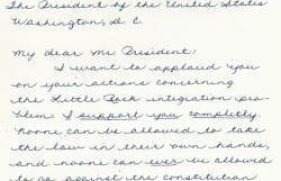
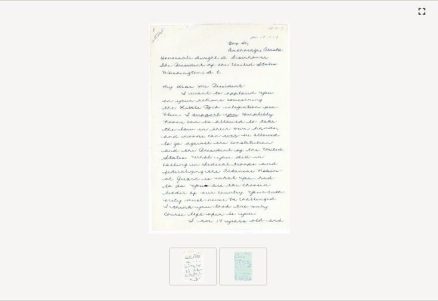
Direct students to begin the main activity, which can be done individually or in pairs. Students will be instructed to analyze two letters written to President Eisenhower regarding school integration: one in favor and one opposed. Remind students to click on “View Entire Document” to see all pages of the document and to read a transcript of the hand-written letters.
For each letter, students should answer the analysis questions below the documents:
- Who wrote the letter? What can we learn about the author from the document?
- Why did the author write the letter? Quote evidence from the document that tells you this.
- What was happening at the time in history this letter was created?
Then, ask students to compare and contrast the two letters by answering the following question:
- What similarities and differences do you notice in the letters’ style, tone, and message?
When they have finished analyzing each document, students should click on “When You’re Done” where they will be presented with the the following questions to consider in preparation for a class discussion:
- How did the authors support their stance either for or against school integration? What similarities and differences do you notice in their arguments?
- How do both authors refer to foundational documents (e.g., the Constitution) or political rights (e.g., voting) to advance their viewpoints?
If needed, as a part of the activity, provide students with the following historical context on the Little Rock Crisis:
On May 17, 1954, the U.S. Supreme Court ruled in Brown v. Board of Education that segregated schools were “inherently unequal” and ordered that U.S. public schools be desegregated “with all deliberate speed.” In response to the ruling, Little Rock’s school board voted unanimously for a school integration plan that started with the desegregation of the high school in 1957, followed by junior high schools the next year, and elementary schools following. In September, nine Black students – collectively known as the “Little Rock Nine” – enrolled at Central High School in Little Rock.
The ensuing struggle between segregationists and integrationists, Arkansas Governor Orval Faubus, and the federal government (especially President Dwight D. Eisenhower himself) became known as the “Little Rock Crisis.” On September 4, the nine Black students attempted to enter Central High. The students were turned away and denied entry by the Arkansas National Guard. That evening, Governor Faubus revealed that he had ordered the National Guard to prevent the Black students from entering.
President Dwight D. Eisenhower, as the chief law enforcement officer of the United States, was presented with a difficult problem. He was required to uphold the Constitution and the laws, but he also wanted to avoid a bloody confrontation in Arkansas. With Executive Order 10730, the President placed the Arkansas National Guard under federal control and sent 1,000 U.S. Army paratroopers from the 101st Airborne Division to assist them in restoring order in Little Rock.
Connection to the Declaration of Independence: If using this activity as part of a broader civics lesson, explain to students that, in the longest section of the Declaration of Independence, colonists submitted facts to a candid world, or a list of grievances, against King George III justifying their decision to declare independence from Great Britain. While the authors of the two letters examined in this activity have different opinions on school integration, both authors “submit facts” or reasons to President Eisenhower to support their stance. In fact, both authors rely on foundational documents (e.g., the Constitution) or political rights (e.g., voting) to advance their claims.
For additional materials related to School Integration: The Little Rock Crisis (including Guiding Questions, National Standards, Historical Background and Supplemental Educational Resources).

To the extent possible under law, National Archives Foundation has waived all copyright and related or neighboring rights to “School Integration: The Little Rock Crisis”
Description
In this activity, students will compare and contrast two letters written to President Dwight D. Eisenhower about the desegregation of Central High School in Little Rock, Arkansas to analyze differing perspectives on school integration.
Share this activity with your students
Documents in this Activity

Letter to Eisenhower against School Integration
Postwar United States (1945 to early 1970s)