

Prohibition and Its Consequences (Laura Elder)

Weighing the Evidence
Share to Google Classroom
Published By:
Laura Elder
Historical Era:
The Emergence of Modern America (1890-1930)
Thinking Skill:
Historical Issues-Analysis & Decision-Making
Bloom’s Taxonomy:
Analyzing
Grade Level:
High School
Suggested Teaching Instructions
This activity can be used during a unit on Prohibition or the 1920s for an American History course, or for a unit in a government course focusing on the role of government in citizens’ lives. For grades 9–12. Approximate time needed is 45 minutes.
Begin by providing students with historical context as to how and why the 18th Amendment, or Prohibition, was passed:
By the turn of the 20th century, temperance societies were prevalent in the United States. Concerned citizens had begun warning others about the effects of alcohol nearly 100 years earlier. In 1826 the American Temperance Society was founded to convince people to abstain from drinking. Not long after, the Women’s Christian Temperance Union pledged not only to ban alcohol and drugs, but to improve public morals. The anti-Saloon League was formed in 1893 and eventually became a powerful political force in passing a national ban on alcoholic beverages.
Women were strongly behind the temperance movement, for alcohol was seen as the destroyer of families and marriages. Husbands might spend their money on alcohol, leaving wives without money to provide for their children.
Factory owners also supported temperance because of the new work habits that were required of industrial workers: early mornings and long nights.
Progressive reformers also took to Prohibition since they saw it as a continuation of their efforts to improve society in general. Temperance societies and Progressives alike saw the need for more governmental control and involvement in citizens’ lives.
Prohibition was enacted to protect individuals and families from the “scourge of drunkenness.” However, it had unintended consequences including: a rise in organized crime associated with the illegal production and sale of alcohol, an increase in smuggling, and a decline in tax revenue.
Encourage students to keep the following questions, and their first reactions to them, in mind as they complete the activity and analyze primary sources:
- Was Prohibition necessary to protect individuals and families?
- Was it the Government’s role to step in and protect them?
- Was Prohibition an unwarranted overreach by the U.S. Government?
Open the activity and select one of the documents. Model careful document analysis, ending with the question Was Prohibition necessary to protect citizens or was it an unwarranted overreach by the Government? based on this document. Demonstrate how the scale works and ask students to place the document they just examined on the scale according to the interpretation it best supports.
Explain to the students that they will need to place each photograph and textual document on the scale based on careful document analysis.
After students complete the activity, they should click “When You’re Done” and answer the questions listed:
- On which side of the scale did most of your evidence fall?
- Why did you tip the scale the way you did?
- Do you think Prohibition was a success? Why or why not?
Conduct a class discussion based on students’ answers. Then, ask a final question for discussion: What lessons can be learned from Prohibition to help inform today’s movement to legalize marijuana?
This activity was created by National Archives volunteer Cynthia Peterman.

To the extent possible under law, Laura Elder has waived all copyright and related or neighboring rights to “Prohibition and Its Consequences (Laura Elder)”
Description
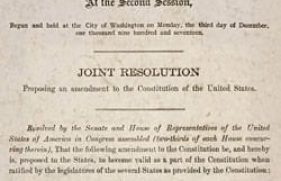
This activity asks students to study documents and images related to the Eighteenth Amendment of 1919 prohibiting the trade in liquor.
Documents include: the Act and its repeal by President Franklin D. Roosevelt in 1933; letters from citizens for and against Prohibition; and photos and political cartoons. Using these artifacts students will decide whether Prohibition was necessary to protect the individual and family, or it was unwarranted over-reach by the U.S. government.
Share this activity with your students
Documents in this Activity
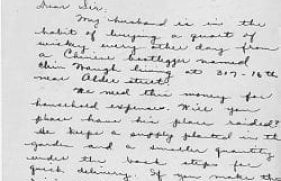
Letter from Mrs. Hillyer concerning her husband's drinking activities.
The Emergence of Modern America (1890-1930)
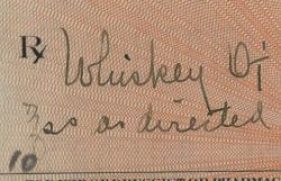
Prescription for Whiskey for I. F. Johnson
The Emergence of Modern America (1890-1930)