

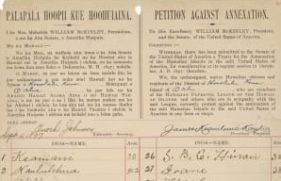
Petition Against Annexation of Hawaii

White Out/Black Out
Share to Google Classroom

Recommended Activity
Published By:
National Archives Foundation
Historical Era:
The Emergence of Modern America (1890-1930)
Thinking Skill:
Historical Analysis & Interpretation
Bloom’s Taxonomy:
Analyzing
Grade Level:
Middle School, High School
Suggested Teaching Instructions
This activity is designed for a unit concerning American Imperialism. For grades 6-12. Approximate time needed is 10-15 minutes.
Begin the activity and ask students to examine the document and answer the following questions:
- What type of document is it?
- Who wrote the document?
- To whom was it written?
- What is the date of the document?
- Why do you suppose it was written in two languages?
- What was the purpose of the document?
When students are finished, they should click on “When You’re Done” and respond to the follow-up questions:
- What potentially annexed territory is this petition about? Cite specific evidence from the document to support your analysis.
- If this petition was signed by over 50% of the native population, do you think the United States should have annexed it? Why or why not?
Based on the evidence, discuss students’ hypotheses about which annexation in U.S. history this petition is about. After discussing their educated guesses, inform students that it is a petition against the U.S. annexation of Hawaii.
Provide the following additional background information to discuss why this annexation was considered controversial:
This is just one of 556 pages in this Hawaiian Patriotic League petition that was signed by over 21,000 native Hawaiians (out of a population of under 40,000). The petition contributed to a defeat of a proposed treaty to annex Hawaii.
Hawaii’s monarchy, Queen Lili’uokalani, had been overthrown in a bloodless coup with the help of the U.S. government. The new government of the declared “Republic of Hawaii” was run by a group of non-native U.S. businessmen and politicians with sugar interests. They were in favor of annexation to protect Hawaii’s free-trade status since the United States was the major importer of Hawaiian agricultural products.
Delegates of the native Hawaiian group came to Washington, DC, with the petition and met with Queen Lili’uokalani, who was already in Washington lobbying against annexation. After meeting with members of Congress and voicing their opposition, only 46 senators were in favor of the resolution to annex Hawaii, less than the 2/3 majority needed for approval of a treaty.
The victory was short-lived, however. Lili’uokalani never regained power because leaders of the Republic of Hawaii refused to turn over power. Then unfolding world events forced the annexation issue to the fore again. On February 15, 1898, the U.S. Battleship Maine was blown up in Havana Harbor in Cuba. The ensuing Spanish-American War, part of which was fought in the Philippine Islands, established the argument that the Hawaiian islands would be strategically valuable as a mid-Pacific fueling station and naval installation.
Pro-annexation forces in Congress submitted a proposal to annex the Hawaiian Islands by joint resolution, a process requiring only a simple majority in both houses of Congress. This eliminated the 2/3 majority needed to ratify a treaty. On July 12, 1898, the Joint Resolution passed and the Hawaiian islands were officially annexed by the United States.

To the extent possible under law, National Archives Foundation has waived all copyright and related or neighboring rights to “Petition Against Annexation of Hawaii”
Description
This activity explores a petition signed by over 21,000 native Hawaiians against a treaty that would have annexed Hawaii to the United States. Students need to figure out what potentially annexed territory the petition is about.