

Patent Analysis: Thomas Edison’s Kinetoscope

White Out/Black Out
Share to Google Classroom
Recommended Activity
Published By:
National Archives Foundation
Historical Era:
The Emergence of Modern America (1890-1930)
Thinking Skill:
Historical Analysis & Interpretation
Bloom’s Taxonomy:
Analyzing
Grade Level:
Upper Elementary
Suggested Teaching Instructions
This activity can be used during a unit on mass media, inventions and innovations, and/or to build document analysis skills in younger students. For grades grades 3-6. Approximate time needed is 15-20 minutes.
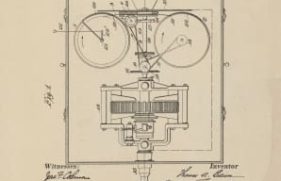
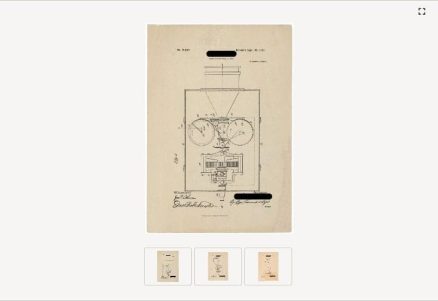
Ask students to look at the partially obscured patent drawing. Without providing any context, model document analysis:
- Quickly scan this document. What do you notice first?
- Describe the document and the invention it depicts as if you were explaining it to someone who can’t see it.
- Based on what you can see, what do you think is the purpose of this invention? List evidence from the document to explain your opinion.
After some discussion, reveal that this is a patent drawing for an important invention. If students are unaware of the definition of a patent, provide a brief definition that a patent gives an inventor a temporary monopoly on his or her invention. Explain how in the United States, the Constitution gave Congress the power to “To promote the progress of science and useful arts by securing for limited times to authors and inventors the exclusive right to their respective writings and discoveries” in Article I, Section 8.
Ask students to offer educated guesses as to the specific invention. If no one guesses movie camera, provide the following clues from the inventor’s description of the invention:
- “The purpose I have in view is to produce pictures representing objects in motion throughout an extended period of time” which may be utilized to exhibit the scene including such moving objects in a perfect and natural manner by means of a suitable exhibiting apparatus
- “By taking the photographs at a rate sufficiently high as to result in persistence of vision the developed photographs will, when brought successively into view by an exhibiting apparatus, reproduce the movements faithfully and naturally.”
Following a brief discussion and potential guesses, provide the following context for the invention. As you provide this information, ask if students can guess the invention.
Machines such as this invention would show a series of moving images like a horse running or a woman dancing. People would watch these short films on this coin-operated invention by pressing their eye to a small hole in the large cabinet.
As the technology progressed, more complex pictures such as boxing matches or short news segments were projected onto a screen. Even still, these were more of a novelty than anything else.
Moving images changed in 1903 with the debut of The Great Train Robbery. Produced by the inventor Thomas Edison himself, the film began to shift the focus from novelty films to plot-based cinema.
After sharing this historical context, ask students to brainstorm how motion pictures (or movies) have been used in other ways in history and today. What positive effects has this invention had over time? What negative effects has this invention had over time?

To the extent possible under law, National Archives Foundation has waived all copyright and related or neighboring rights to “Patent Analysis: Thomas Edison’s Kinetoscope”
Description
In this activity, students will analyze Thomas Edison’s patent drawings for a kinetoscope, a forerunner to the motion picture – or movie – camera.