

Passover Holiday: Two Seder Celebrations

Compare and Contrast
Share to Google Classroom
Published By:
Kathy Blessing, Community College of Rhode Island Library (Flanagan Campus)
Historical Era:
Across Eras: Civics & Government
Thinking Skill:
Historical Analysis & Interpretation
Bloom’s Taxonomy:
Analyzing
Grade Level:
Upper Elementary, Middle School
Suggested Teaching Instructions
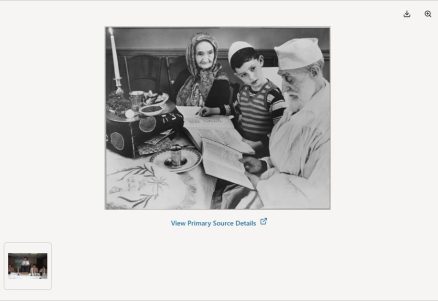
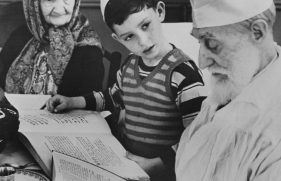
The sequence of questions walks students through several features of two photographs of Jews participating in the ritual Seder meal. The 1951 image presents an intimate, multi-generational domestic setting while the 1985 one presents a far-away from home location – aboard a Navy ship. Students consider the physical settings, types of people and objects in the images. The rich details in the images are explored (participants and objects). Further research is encouraged (what Passover is and elements of observance). The exercise, appropriate for individual or group work, may be completed in one to two hours. It may be used in class or outside of class by students at the middle school through undergraduate levels. Older students would be expected to provide more detailed responses that indicate a deeper view of the images and demonstrate a more precise understanding of the holiday based on selected background sources.
The questions, which support visual learning, are borrowed from various primary source analysis worksheets (and related texts). The worksheets were created by the NARA and the LOC for use by educators. The documentation may be found through links on following web pages:
- “Document Analysis Worksheets” http://www.archives.gov/education/lessons/worksheets/
- “Using Primary Sources” http://www.loc.gov/teachers/usingprimarysources/
Suggested sources for background information to the photos include:
- The BBC – Religions: Judaism, Passover http://www.bbc.co.uk/schools/religion/judaism/passover.shtml
- Judaism 101 – Pesach (Passover) http://www.jewfaq.org/holidaya.htm.

To the extent possible under law, Kathy Blessing, Community College of Rhode Island Library (Flanagan Campus) has waived all copyright and related or neighboring rights to “Passover Holiday: Two Seder Celebrations”
Description
The activity encourages a slow, holistic examination of two photographs of individuals particpating in seder meals. Through the exercise learners practice sustained attention and detailed investigation. Since students may be unfamiliar with the Passover (Pesach) holiday and the Seder meal, it would be helpful to review basic aspects of the meal and the holiday so they are properly oriented before starting the exercise. Some learners may initially find the process challenging since the communication style they are most familiar with involves abbreviated messages appropriate for instantaneous viewing and replying.
Share this activity with your students
Documents in this Activity
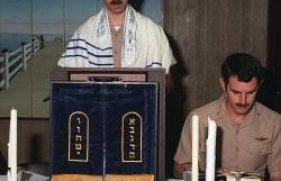
Crew members participate in the Jewish celebration of Passover
Contemporary United States (1968 to the present)