

Oh Freedom! Sought Under the Fugitive Slave Act

Making Connections
Share to Google Classroom
Recommended Activity
Published By:
National Archives Foundation
Historical Era:
Civil War and Reconstruction (1850-1877)
Thinking Skill:
Historical Analysis & Interpretation
Bloom’s Taxonomy:
Creating
Grade Level:
Middle School, High School
Suggested Teaching Instructions
Use this activity in a unit about slavery, emancipation, or the Civil War, or to address the essential questions: When is it OK to break the law? Would I have the courage to take huge risks for important causes?
The activity is appropriate for students in grades 6–12 working in small groups; however, the story can be adapted for younger students. Approximate time needed is 50 minutes; it benefits from background understandings and could be paired with additional readings or excerpts. Note that the documents are in 19th-century cursive, but explanation and quotations are provided in the activity.
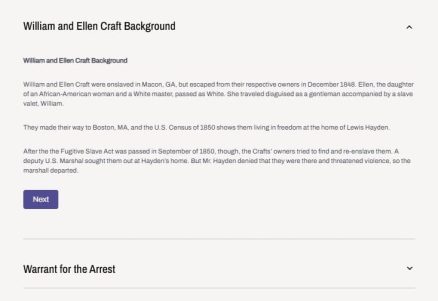
This activity includes primary sources from the official records of the U.S. District Court at Boston that tell the story of William and Ellen Craft, a young couple from Macon, Georgia, who escaped to freedom in Boston in 1848. The two traveled together, Ellen as a White gentleman (she was the daughter of an African-American woman and a White “master” and passed as White), and William as her enslaved valet. They made their way to Boston, and lived in the home of Lewis Hayden, a former fugitive and abolitionist.
With the passing of the Fugitive Slave Act in September, 1850, the Crafts’ respective “owners” employed the legal system to regain their escaped “property.” A U.S. Marshal was sent to the home of Lewis Hayden. Hayden refused to let the marshal in and threatened to ignite kegs of gunpowder; then Marshal left. Ellen and William fled to Britain, where they remained for 20 years. They eventually returned to the United States and settled back in Georgia.
Learning Objective:
- Students will construct historical narratives to tell the story of two individuals in history based on examination of historical documents as evidence.
Instructions:
- Provide background information and introduce the historical setting, including slavery, the Fugitive Slave Act (you may wish to point students to the Compromise of 1850 that established the stricter fugitive slave act), and the Missouri Compromise.
- Briefly tell the story of the Crafts. Their full narrative Running a Thousand Miles for Freedom is available online from Documenting the American South (DocSouth).
- Form groups of 2–3 students each; direct them to launch the activity and explore the documents together.
- After they have advanced through the activity and clicked “I’m Done,” each group will be directed to create a topic sentence, told in either 1st or 3rd person, that introduces the most important point of the story.
- Ask students to share their topic sentences with the class. Then assign students, either in their groups or individually, to write narratives telling the Crafts’ story, quoting from the historical documents they have seen.
Sample story starters that students may come up with are:
- They thought they were finally free.
- A White gentleman traveling alone on a train is not so unusual; but sometimes things are not what they seem.
- I could not give them up to the authorities, even if I risked my career.
- They were all I had, and I couldn’t afford not to get them back.
- Sometimes, you just have to do the right thing.

To the extent possible under law, National Archives Foundation has waived all copyright and related or neighboring rights to “Oh Freedom! Sought Under the Fugitive Slave Act”
Description
In this activity, students will examine primary sources related to a couple, William and Ellen Craft, who escaped slavery and were considered fugitives. Using the documents, students will construct historical narratives to tell the Crafts’ story, learning that enslaved people struggled to free themselves and loved ones, one person at a time.
They can explore perspective and use standard elements of writing (plot, character, setting, conflict, impact). Thinking about essential questions and topics, they will begin their writing with a topic/opening sentence that sets out the main idea.
Share this activity with your students
Documents in this Activity
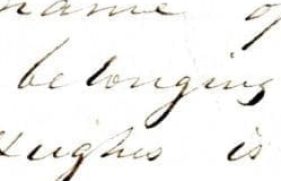
Robert Collins' Power of Attorney
Expansion and Reform (1801-1861)
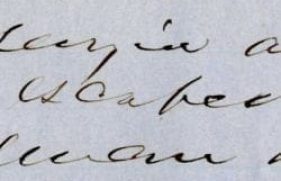
John Knight's Affidavit Confirming He Knew Ellen Craft as Robert Collins' Slave
Expansion and Reform (1801-1861)
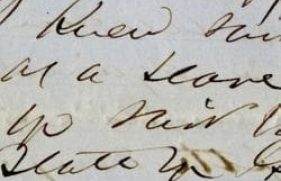
John Knight's Affidavit Confirming He Knew William Craft as Ira H. Taylor's Slave
Expansion and Reform (1801-1861)