

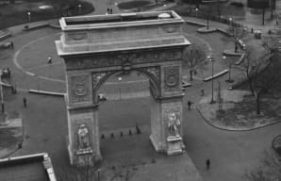
Memorials, Statues, and Monuments to George Washington

Making Connections
Share to Google Classroom
Recommended Activity
Published By:
National Archives Foundation
Historical Era:
Across Historical Eras
Thinking Skill:
Historical Analysis & Interpretation
Bloom’s Taxonomy:
Analyzing
Grade Level:
Middle School, High School
Suggested Teaching Instructions
This activity is intended as wrap-up to a unit on the American Revolution, the Early Republic, or for use when studying monuments and memorials. For grades 6-12. Approximate time needed is 60 minutes.
To begin, ask students to define monument or memorial. After discussing definitions, ask students if they can think of a monument or memorial in their town, city, county or state.
- What does the monument memorialize?
- Why do we memorialize people through sculptures?
Tell students that they will be analyzing multiple statues and monuments across the United States to memorialize our first President – George Washington. Ask students to brainstorm qualities, characteristics, historical events, and other details they associate with George Washington.
Present the activity to the entire class. Model careful analysis with one of the first images for students. Then divide the class into several groups. Assign each group to analyze several statues (3 to 5 statues per group is recommended). Remind them to use the blue buttons at the bottom of the photographs to look at each one more closely.
For each statue, ask students to consider the following:
- What do you see?
- What do you think it represents?
- How do they physically or symbolically depict George Washington?
- What aspects and qualities do they appear to emphasize in their depiction?
Bring the class back together and ask students to report on individual statues as you list out the details. After discussing statues and monuments individually, ask students to note any major similarities and differences between the monuments.
Some of the similarities and differences they may notice include:
- Several of the statues depict George Washington on a horse.
- Sometimes he is depicted in military attire, other times civilian attire.
- George Washington is depicted in various conditions: sitting, standing, on a horse.
- Several of the monuments includes tall vertical column of some sort.
- Several of the monuments include classical design elements from ancient cultures: Egyptian, Greek, or Roman.
Direct students’ attention to the conclusion questions under “When You’re Done.” Discuss their thoughts.
- Which statue, monument, or memorial to George Washington do you think is best? Why?
- If you were to create a statue, monument, or memorial to George Washington today, what characteristics of him as a leader would you emphasize? What details would you include in your statue, monument or memorial? Why?

To the extent possible under law, National Archives Foundation has waived all copyright and related or neighboring rights to “Memorials, Statues, and Monuments to George Washington”
Description
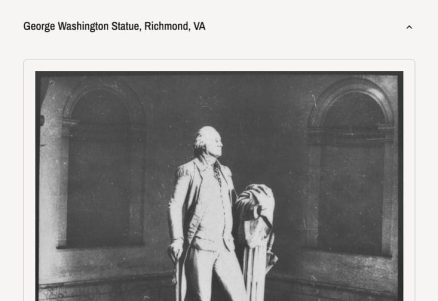
This comparative analysis activity involves comparing and contrasting several statues of George Washington from across the United States, including George Washington (1792) by Jean-Antoine Houdon, Enthroned Washington (1840) by Horatio Greenough, George Washington (1856) by Henry Kirke Brown, and the Washington Monument (1884).
Students will consider the similarities and differences between these multiple depictions and discuss the qualities of George Washington that they emphasize.
Share this activity with your students
Documents in this Activity
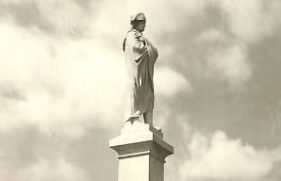
Washington's Crossing Monument
The Emergence of Modern America (1890-1930)
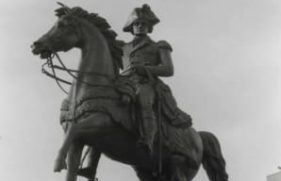
Virginia Washington Monument, Richmond, VA
The Emergence of Modern America (1890-1930)