

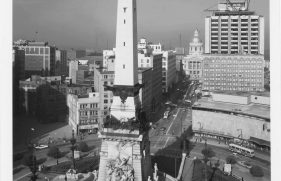
Memorializing the Civil War Around America

Mapping History
Share to Google Classroom

Recommended Activity
Published By:
National Archives Foundation
Historical Era:
Across Eras: Civics & Government
Thinking Skill:
Historical Analysis & Interpretation
Bloom’s Taxonomy:
Analyzing
Grade Level:
High School
Suggested Teaching Instructions
This activity is intended as wrap-up to a unit on the Civil War or for use when studying monuments and memorials. For grades 6-12. Approximate time needed is 90 minutes.
To begin, ask students to define the terms monument and memorial. After discussing definitions, ask students if they can think of a monument or memorial in their town, city, county, or stat
- What does the monument memorialize?
- Why do we memorialize people through sculptures?
Display for students the map and documents. Inform students that four photographs have already been placed in their correct locations, while others need placing on the United States map. Model document analysis with the photographs already pinned on the map.
For each statue, ask students to consider the following:
- What do you see? What do you think it represents?
- How do they physically or symbolically depict Civil War leaders or soldiers?
- What aspects and qualities do they appear to emphasize in their depiction?
Ask students to compare and contrast how the civilian (Abraham Lincoln and Jefferson Davis) and military (Ulysses S. Grant and Robert E. Lee) leaders of the of the United States and the Confederacy were depicted.
Next, divide the class into several groups. Each group will analyze all of the remaining statues. Instruct students to perform the same careful examination above for each remaining photograph. Remind them to click on the orange “open in new window” icon for each photographto see it more closely, find additional images, and read background information. As they analyze, direct students to place the photographs in their correct locations on the map.
As they place the photographs, direct students to note particular details about the statues in a multi-column chart. Columns could include: Subject Matter, Union or Confederacy, Location (City, State and Specific Area), Connection between Monument and Location, Unique Features, etc.
| Subject Matter | Union or Confederacy | Location of Monument (City, State; Area) | Connection between Monument & Location | Unique Features |
| Abraham Lincoln | Union | Lincoln, NE, Nebraska State Capitol Grounds |
City named after Abraham Lincoln | Architect and Sculptor later collaborated on Lincoln Memorial |
| Jefferson Davis | Confederacy | Montgomery, AL, Alabama State Capitol Grounds | Former Confederacy Capitol | |
| Ulysses S. Grant | Union | Philadelphia, PA, Fairmount Park | Unknown | |
| Robert E. Lee | Confederacy | Charlottesville, VA, Market Street Park (formerly known as Lee Park) | Home state of Robert E. Lee | Potential removal led to the Unite the Right rally in Charlottesville, Virginia, in 2017 |
Bring the class back together and ask students to report on individual statues. After discussing several statues and monuments individually, ask students to note any major similarities and differences between the monuments.
Similarities and differences between the monuments might include:
- Military leaders are often depicted in equestrian statues.
- Several statues use angelic allegorical female figures in their depictions.
- Many statues are located in public spaces of importance, such as near county court houses or in major squares in their respective cities.
Ask students if any statues stand out as different or unique. Examples may include:
- The Minnesota Monument in Little Rock, Arkansas, is a Union monument to a Northern state’s soldiers in a former Confederacy southern state.
- The Confederate Soldier Memorial in Columbus, Ohio, is a Confederacy monument to Southern soldiers in a northern Union state.
- The Union/Confederate Veteran’s Monument in Morgantown, Kentucky, and the Missouri Memorial in Vicksburg, Mississippi, honor both Union and Confederate soldiers from their respective places.
After discussing similarities and differences, direct students to click on “When You’re Done.” Conduct a discussion based on several of the following questions:
- Should the statues to Confederate leaders and soldiers be removed? Why or why not?
- Do you think that all the Confederate statues should remain? That all the Confederate statues should be removed? Or should it be a case-by-case situation?
- Who should make the decision for statues to remain or be removed? How should these decisions be made?
- Is there a difference between statues of specific Confederate military and civilian leaders (such as Robert E. Lee) and those made to Confederate soldiers from that area (such as soldiers from Arkansas)? Why or why not?
- Should the specific location of a statue impact the decision to keep or remove it?
- Is there a difference between having statues in public spaces (like court houses and state capitols) and ones that are in private cemeteries or on Civil War battlefield sites? Why or why not?
Inform students that many of the statues in this activity have been removed – either by protestors, or by local or state authorities – in the past several years. For others, people have attempted to remove them, or there have been petitions or discussions about their removal. If interested, students can look at each photograph’s detail page (by clicking the orange “open in new window” icon) to see the current status of each statue.

To the extent possible under law, National Archives Foundation has waived all copyright and related or neighboring rights to “Memorializing the Civil War Around America”
Description
In this activity, students will analyze photographs of statues, monuments, and memorials dedicated to the Civil War from across the United States. Students will place the statues, monuments, and memorials in the appropriate location where they were erected and analyze how the North and South memorialized the Union and the Confederacy’s leaders and soldiers in the decades following the Civil War.
Share this activity with your students
Documents in this Activity
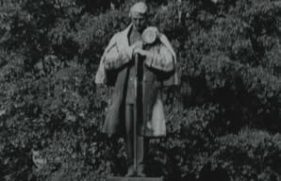
Minnesota Monument, Little Rock, AR
The Emergence of Modern America (1890-1930)
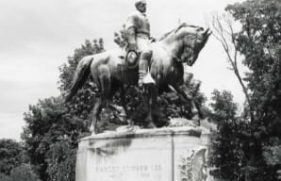
Robert Edward Lee Sculpture, Charlottesville, VA
The Emergence of Modern America (1890-1930)
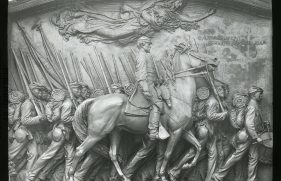
Shaw Memorial, Boston Common, Boston, MA
The Development of the Industrial United States (1870-1900)

