

Marian Anderson Concert at the Lincoln Memorial

Analyzing Documents
Share to Google Classroom

Recommended Activity
Published By:
National Archives Foundation
Historical Era:
The Great Depression and World War II (1929-1945)
Thinking Skill:
Historical Analysis & Interpretation
Bloom’s Taxonomy:
Analyzing
Grade Level:
Upper Elementary, Middle School
Suggested Teaching Instructions
This activity can be used as an introduction to the Civil Rights movement. For students in grades 4-8. Approximate time needed is 30-40 minutes. The activity may be particularly appealing to students who are strong auditory learners.
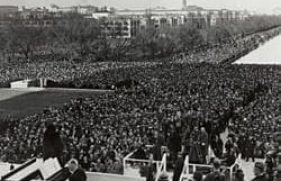
Display Photograph of 75,000 People Gathered to Hear Singer Marian Anderson in Potomac Park. Discuss the following questions briefly with students:
- What do you see?
- What are the people doing in the photo?
- Where do you think this photo was taken?
- Write two words that describe the photo.
Discuss their answers. Students may recognize the location and hypothesize that this photograph was taken at the famous March on Washington for Jobs and Freedom in 1963. Inform the students that the photograph in fact depicts an important event from decades earlier—the Easter Sunday Concert by world famous contralto, Marian Anderson on April 9, 1939.
Segue with a brief discussion with students about what it was like to live in the racially segregated society of the United States in 1939. Consider the following questions:
- What were Jim Crow laws?
- What were impacts of segregation on the lives of African Americans?
Share the following historical information with students:
In 1939 in Washington, DC, African American students could not attend the same schools as white students, African Americans could not eat in the same restaurants as white people, African Americans lived in segregated neighborhoods, and they used bathrooms and drank from water fountains designated for ‘colored’ people. African Americans had to go to segregated beaches and pools. Yet, on April 9, 1939, a mixed-race crowd of over 75,000 people gathered in front of the Lincoln Memorial to hear one of the greatest contraltos in the world, Marian Anderson who was an African American.
Marian Anderson was known as one of the finest contraltos (a classical female singing voice that is the lowest female voice type) in the world of her time. Anderson’s vocal talent was apparent from an early age. She sang in the choir at the Union Baptist Church from age 6. Members of the congregation raised money to send Anderson to music school for one year. Voice teacher, Giuseppe Boghetti, was so impressed with her talent that he gave her free lessons.
Anderson went on to win competitions and begin a career as a singer. Anderson toured Europe several times and South America always to great acclaim. Many concert venues in the United States were closed to her because of the Jim Crow laws at the time. In 1939, Howard University attempted to host a Marian Anderson concert at DC’s Constitution Hall (the largest indoor venue in the city) which was owned by the Daughters of the American Revolution (DAR). When they refused due to her race, Howard University, the NAACP, and first lady Eleanor Roosevelt arranged for the concert to be held in front of the Lincoln Memorial.
Students can complete the activity individually or in small groups (listening to the recording on headphones or as the entire class). Direct the students to open the link to the recording. Ask the students to listen to the first seven minutes of the recording. Inform students that the first seven minutes include a brief introduction by National Broadcasting Corporation (NBC), Secretary of the Interior Harold L. Ickes’ introduction to Marian Anderson, and Marian Anderson singing “America: My Country Tis of Thee.”
As students listen to the recording, direct students to complete the sound recording analysis. If necessary, play certain aspects of the recording several times. For the first section of the recording with the NBC radio announcer, model document analysis:
- Meet the Sound Recording
- Observe its Parts
- Try to Make Sense of It
- Use it as Historical Evidence
After students have listened to the recording and completed the analysis of the recording direct students to complete the When You’re Done question.
- Why might Marian Anderson’s concert at the Lincoln Memorial on April 9, 1939, be viewed as an early victory for the Civil Rights movement?
Students who are interested in the topic may continue to research the Marian Anderson concert on the steps of the Lincoln Memorial on April 9, 1939. First Lady Eleanor Roosevelt was instrumental to finding a venue for Marian Anderson after the Daughters of the American Revolution (DAR) refused to allow the use of Constitution Hall. Examine a variety of documents related to the Marian Anderson’s Easter Concert at the Lincoln Memorial by searching for documents related to Marian Anderson in DocsTeach.

To the extent possible under law, National Archives Foundation has waived all copyright and related or neighboring rights to “Marian Anderson Concert at the Lincoln Memorial”
Description
In this activity, students will listen to and analyze approximately seven minutes of Marian Anderson’s concert at the Lincoln Memorial in Washington, DC on Easter Sunday April 9, 1939.