


Making Connections: Women’s Suffrage Movement

Making Connections
Share to Google Classroom

Recommended Activity
Published By:
National Archives Foundation
Historical Era:
The Emergence of Modern America (1890-1930)
Thinking Skill:
Historical Analysis & Interpretation
Bloom’s Taxonomy:
Analyzing
Grade Level:
Upper Elementary
Suggested Teaching Instructions
This activity can be used during a unit on the women’s suffrage movement, civic action, or during a unit on the Declaration of Independence.
Begin the activity by asking students to share the details they notice about the Petition for Universal Suffrage. Ask students to focus on the following questions when examining the document:
- Who wrote this document?
- What do the creators of this document want? What are some of the reasons the creators of the petition gave for supporting women’s suffrage?
Share the following contextual information with students about the petition:
This document is an example of a petition. The First Amendment protects a person’s right to petition the government to address a problem. Petitions are often written requests signed by many people, like the example in this activity. This petition was part of the first national drive to focus on women’s voting rights and includes signatures of some of the most prominent advocates at the time: Susan B. Anthony, Elizabeth Cady Stanton, Ernestine Rose, Lucy Stone, and Antoinette Brown Blackwell. It asks for an amendment to the Constitution that shall prohibit the several states from disfranchising any of their citizens on the grounds of sex.
Next, ask students to spend a minute or two looking at the photograph of “Silent Sentinel” Alison Turnbull Hopkins outside the White House. Then ask students the following questions about the photograph:
- What do you see?
- What are the people doing in the photo?
- What does the message on her banner mean?
Share the following contextual information with students about the photograph:
This photograph of “Silent Sentinel” Alison Turnbull Hopkins outside the White House shows women taking action to press for voting rights for women. Her banner reads: “Mr. President How Long Must Women Wait for Liberty.” Frustrated with President Woodrow Wilson’s inaction on woman suffrage, the National Women’s Party (NWP) peacefully protested six days a week in January 1917, but encountered hostile crowds after the United States entered World War I in April. Dozens of women were arrested, many of whom were jailed and force-fed. The resulting publicity and public outcry over their treatment is often credited with compelling President Woodrow Wilson to support women’s suffrage. The protesters demonstrated for nearly 30 months until Congress passed a joint resolution proposing a 19th amendment on June 4, 1919.
Ask students how this information changes their understanding of the photograph.
Divide students into small groups or pairs to analyze the final document, the cartoon titled Let the People Vote on it.
- What do you see?
- What are the people doing in the cartoon?
- What is the main idea of the cartoon?
Share the following contextual information with students about the photograph:
This cartoon shows a woman pointing at the “Anthony Suffrage Amendment.” The woman in this cartoon is protesting the delay of the “Susan B. Anthony Amendment” by the U.S. Senate, which is denying the States a chance to vote on this important issue. (The House passed the amendment in January 1918.) The artist is calling for immediate action on the amendment, which would grant women the right to vote. This cartoon reminds us of one way people can use their voice to fight for change when they think something is wrong in the United States.
After analyzing the documents, ask students to reflect on the ideals promised to us by the Declaration of Independence:
The Declaration of Independence emphasizes the importance of the individual and individual rights – all men are created equal. However, at the time of the Declaration’s adoption in 1776, women had few political rights and were not permitted to vote or hold office. The Declaration of Sentiments was written at the first women’s rights convention in American history at Seneca Falls, New York, in 1848. Organized by Elizabeth Cady Stanton, Lucretia Mott, and other women’s rights and anti-slavery activists. The language in the Declaration of Sentiments was inspired by the Declaration of Independence. In proclaiming that, “we hold these truths to be self-evident: that all men and women are created equal,” the Declaration of Sentiments replaced colonists’ grievances against a tyrannical king with the injustices women endured. These included women’s inability to control property, limited educational and professional opportunities, and the right to vote.
Ask students the following questions:
- How have people used their voice to fight for equality?
- What are some other ways people can use their voice when they think something is wrong?
- Reflect on an issue that is important to you. Think of a phrase or symbol that you could put on a banner or in a cartoon to push for change.
Share with students that change can take a long time. The rights and freedoms embodied in the Declaration of Independence did not initially apply to all Americans. Groups in American society have struggled to achieve the liberties and equality promised in the principles of American democracy. The first women’s suffrage amendment was introduced in Congress in 1878. For the next 40 years, it was reintroduced regularly, becoming popularly known as the Susan B. Anthony Amendment. Activists spent decades organizing, petitioning, marching, staging hunger strikes, and holding silent vigils before its passage extended full voting rights to women. These documents remind us of the ways in which individuals used their voice to fight for change: right to petition, freedom of speech, and the right to protest. The amendment was reintroduced in 1919, and this time both the House and Senate passed it. It then went to the States for ratification. On August 18, 1920 – after ¾ of the states ratified the amendment – the 19th amendment was added to the Constitution.
For additional materials related to Making Connections: Women’s Suffrage Movement (including Guiding Questions, National Standards, Historical Background and Supplemental Educational Resources).

To the extent possible under law, National Archives Foundation has waived all copyright and related or neighboring rights to “Making Connections: Women’s Suffrage Movement”
Description
In this activity, upper elementary school students will analyze documents related to the women’s suffrage movement and will identify ways in which people used their voice to fight for women’s right to vote.
Share this activity with your students
Documents in this Activity
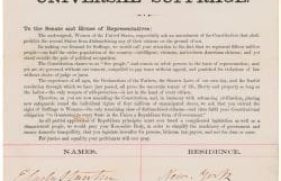
Petition for Universal Suffrage
Civil War and Reconstruction (1850-1877)

Flag Bearer for Women's Rights Standing Near White House
The Emergence of Modern America (1890-1930)