

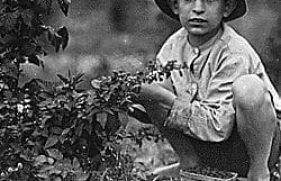
Lewis Hine Shedding Light on Child Labor through Photographs

Making Connections
Share to Google Classroom

Recommended Activity
Published By:
National Archives Foundation
Historical Era:
The Emergence of Modern America (1890-1930)
Thinking Skill:
Historical Analysis & Interpretation
Bloom’s Taxonomy:
Analyzing
Grade Level:
Middle School, High School
Suggested Teaching Instructions
This activity can be used during a unit on the Industrial Revolution or the Progressive Era. For grades 6-12. Approximate time needed is 60 minutes.
To begin, ask students to quickly scan all of the photographs in the activity before choosing four for deeper analysis. For the photographs that students choose to analyze, tell them to respond to the following in the blank box following each photo:
- Quickly scan the photo. What do you notice first?
- List the people, objects and activities you see.
- Where is it from?
- When is it from?
- Write one sentence summarizing this photo.
- What did you find out from this photo that you might not learn anywhere else?
After analyzing four photographs individually, place students in small groups to compare and contrast their findings. Once they are familiar with each other’s photographs, ask them to compile a list of adjectives that they think describe the life of a child working at the turn of the 20th century (the task presented under “When You’re Done”).
Ask students to discuss these adjectives in their small groups. For specific adjectives, prompt students to explain their choices with specific evidence from the photographs. Bring the class back together and discuss their findings, posting them for the entire class to see.
Provide some additional context about reforms to end child labor:
By the early 1900s many Americans were calling child labor “child slavery” and were demanding an end to it. In 1904 a group of progressive reformers founded the National Child Labor Committee and received a charter from Congress in 1907. It hired investigators like Lewis Hine to gather evidence of children working in harsh conditions, to try to abolish child labor.
Hine believed that if people could see for themselves the abuses and injustice of child labor, they would demand laws to end those evils. By 1916, Congress passed the Keating-Owens Act that established the following child labor standards: a minimum age of 14 for workers in manufacturing and 16 for workers in mining; a maximum workday of 8 hours; prohibition of night work for workers under age 16; and a documentary proof of age.
Unfortunately, this law was later ruled unconstitutional on the ground that congressional power to regulate interstate commerce did not extend to the conditions of labor. Effective action against child labor had to await the New Deal. Reformers, however, did succeed in forcing legislation at the state level banning child labor and setting maximum hours. By 1920 the number of child laborers was cut to nearly half of what it had been in 1910.
This activity was adapted from “Lewis Hine Shedding Light on Child Labor” in the New York City Department of Education’s Passport to Social Studies, Grade 8, Unit 2, Day 22 (pg. 57).

To the extent possible under law, National Archives Foundation has waived all copyright and related or neighboring rights to “Lewis Hine Shedding Light on Child Labor through Photographs”
Description
In this activity, students will analyze a series of photographs taken by renowned photographer Lewis Hine to reflect on child labor in the early 20th century. The holdings of the National Archives include hundreds of photographs taken by Hine as part of his work for the National Child Labor Committee.
Share this activity with your students
Documents in this Activity
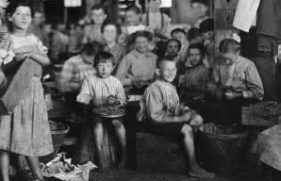
Stringing Beans for the J.S. Farrand Packing Co.
The Emergence of Modern America (1890-1930)

Girl working in Box Factory. I saw 10 small boys and girls working. Has a bad reputation for employment of youngsters, but work is slack now. Tampa, Fla.
The Emergence of Modern America (1890-1930)
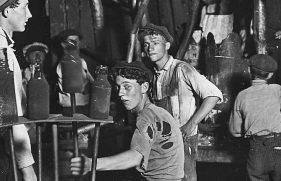
9 P.M. in an Indiana Glass Works. Indiana
The Emergence of Modern America (1890-1930)