


Lewis & Clark’s Expedition to the Complex West

Mapping History
Share to Google Classroom
Recommended Activity
Published By:
National Archives Foundation
Historical Era:
Expansion and Reform (1801-1861)
Thinking Skill:
Historical Analysis & Interpretation
Bloom’s Taxonomy:
Analyzing
Grade Level:
High School
Suggested Teaching Instructions
Use this activity as an introduction to, or for a closer study of, the Lewis and Clark Expedition. It is appropriate during a unit on early westward expansion, Thomas Jefferson’s presidency, or when discussing land rights and ownership in the West. Students can complete the activity individually, in pairs, or in small groups. For grades 9-12. Approximate time needed is 45 minutes.
As a class, read the introduction to the activity and discuss the brief historical background provided. Ask students: What issues do you predict the United States would have faced in dealing with these various interests? What do you think would have been the best way for the United States to deal with them?
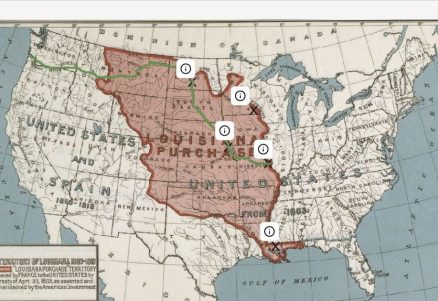
Following discussion, scroll down to the map. Ask students to look carefully at the map and model map analysis for them. Ask students to notice political boundaries and the highlighted portion showing the territory included in the Louisiana Purchase, then to determine the time period that the map depicts. Share with students that it was created for the centennial of the Louisiana Purchase in 1903, and therefore includes state boundaries that were later added to the United States.
Instruct students to begin working independently, individually or in their groups, by looking to the documents below the map. They should analyze each document carefully and determine the people or country referenced in each. Then they should read the hint pins on the map and move each document to the location on the map where that party was located or claimed a stake.
For example, when students read the message from President Jefferson to Congress that sparked the Lewis and Clark Expedition, Jefferson said, in reference to the Mississippi River, “it is however understood that the country on that river is inhabited by numerous tribes, who furnish great supplies of furs [and] peltry to the trade of another nation carried on in a high latitude.” Students should use their background knowledge of the history of North America, any other needed reference materials, and the hint pins on the map, to understand that the nation with interests “in a high latitude” was Great Britain. The hint pin for this document says, “Jefferson worried that British fur traders had too much influence with Native American groups in this part of the West. Move the document that refers to British fur traders here.” Students would then move the document pin for Jefferson’s confidential message to Congress to the location of the hint pin on the map – along the northern Mississippi River.
For reference, the documents, their associated hint pins, and the correct locations are:
- Jefferson’s Message of Relations with the Indians (Hint: Jefferson worried…) – along the northern part of the Mississippi River
- List of Indian Presents (Hint: When the Corps of Discovery began…) – St. Louis, Missouri
- Proclamation of New Orleans (Hint: The port of New Orleans…) – New Orleans, LA
- Captain Lewis to the Otto (Hint: Lewis and Clark modeled…) – with the Oto (Otto) Indians (part of Southern Sioux tribes), on the Missouri River near the border of Missouri and Nebraska
- Jefferson’s message of discoveries of Lewis & Clark (Hint: Captain Lewis and the Corps…) – Fort Mandan in North Dakota
After students have moved all of the documents to the map, they should click on “When You’re Done” where they will be directed to create a list of all of the different people or groups who were involved in the West.
Bring the full class back together to compile a class list of all of the parties involved. The list should include, at minimum, Great Britain, Spain, France, the Oto (Otto), the Missouri, and the Mandan. Ask students to recall mention of these groups from the documents.
Students will also have been asked to think about the following questions in preparation for a class discussion:
- Who owned this land prior to the Louisiana Purchase?
- What would the United States purchasing this land mean to the American Indian tribes living throughout the West?
Discuss students’ responses to these questions. Include discussion about land claims and land rights, that various tribes in this vast territory considered this their homeland and not owned by the French or Americans, and that this was the first step in relations between the American government and American Indian tribes in this area. (Other tribes not mentioned in the documents, but impacted include the Shoshone, Pawnee, Osages, Witchitas, Kiowas, Cheyenne, Crow, Minitari, Blackfeet, Chinook, Sioux, and others.)
Lastly, ask students to describe what they see as the goals of the expedition. Students may identify goals such as: to find a waterway to the Pacific Ocean, to create good relations with Native Americans in the West, to show force over American Indian tribes, or to encourage Native Americans to adopt a lifestyle similar to that of Americans in the East.

To the extent possible under law, National Archives Foundation has waived all copyright and related or neighboring rights to “Lewis & Clark’s Expedition to the Complex West”
Description
In this activity, students will analyze primary sources demonstrating various political interests in the West, including the Spanish, French, British, and those of several Native American tribes, and place them on a historic map of the West (that was created for the centennial of the Louisiana Purchase).
Students will learn that the United States purchased the Louisiana Territory in 1803 and President Thomas Jefferson sent Lewis and Clark to explore west of the Mississippi River in 1804, though the land was already inhabited and politically complicated.
Share this activity with your students
Documents in this Activity

Speech of Captain Meriwether Lewis to the Otto Indians
Expansion and Reform (1801-1861)

Proclamation to the People of New Orleans
Expansion and Reform (1801-1861)

"Indian Presents" Purchased by Meriwether Lewis
Expansion and Reform (1801-1861)