

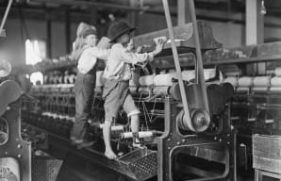
Kids at Work: The Child Labor Debate

Weighing the Evidence
Share to Google Classroom
Recommended Activity
Published By:
National Archives Foundation
Historical Era:
The Emergence of Modern America (1890-1930)
Thinking Skill:
Historical Analysis & Interpretation
Bloom’s Taxonomy:
Analyzing
Grade Level:
Middle School
Suggested Teaching Instructions
This activity can be used in units about the Industrial Revolution, the Progressive Era, child labor, or a civics lesson about the Declaration of Independence or the Bill of Rights. For grades 6-8. Approximate time needed is 45 minutes.
As a warm-up exercise, analyze the Lewis Hine photograph 9 P.M. in an Indiana Glass Works. Indiana together as a class. Ask students to identify the people, objects, and activities they see in the photograph. Then, based on their observations, have students consider why the photograph was taken.
Explain to students that, starting in 1908, photographer Lewis Hine documented child laborers and their working conditions for the National Child Labor Relation Committee, with the objective of eliminating this practice. Hine’s photographs were a part of a larger debate during the early twentieth century around child laborers and whether the federal government should provide stronger protections for children who worked. The documents in this activity reflect this larger debate.
To start the main activity, choose one document and one photograph to display to the full class to model document analysis. Conclude the analysis by asking students to consider which of the following interpretations the document best supports:
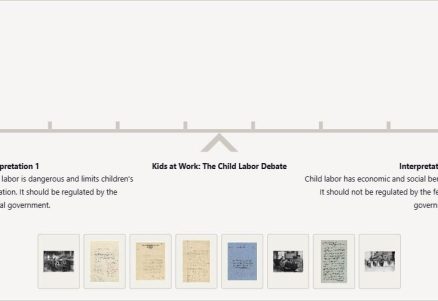
- Interpretation One: Child labor is dangerous and limits children’s education. It should be regulated by the federal government.
- Interpretation Two: Child labor has economic and social benefits. It should not be regulated by the federal government.
Then, direct students to carefully analyze the remaining documents based on the model provided. They should evaluate each document and then move it to a position on the scale according to which interpretation it supports and how strongly.
After they have finished analyzing the documents, hold a class discussion about why they placed specific documents where. As a part of this discussion, have students answer the following questions:
- How did opponents and supporters of child labor and federal regulation of this practice support their positions?
- What connections, if any, exist between these arguments?
When finished, students should click on “When You’re Done” to access the final discussion question presented below:
- Which interpretation did you find the most convincing? Cite specific evidence and arguments from the documents to support your opinion.
Once students have had the opportunity to individually (or in small groups) consider their response to the final discussion question, divide the students into two groups based on their support for either Interpretation One or Interpretation Two. Ask for student volunteers from each group to share their reasons for why they found a particular interpretation most convincing, making sure that they cite specific evidence and arguments from the documents to support their viewpoint. During the process, if students’ opinions change based on a classmate’s evidence, allow them to change positions.
If needed, as a part of the activity, provide students with the following historical context:
As demand for labor grew in the late 19th and early 20th centuries, many children were drawn into the labor force. The number of children under the age of 15 who worked in industrial jobs for wages climbed from 1.5 million in 1890 to 2 million in 1910. Businesses liked to hire children because they worked in unskilled jobs for lower wages than adults, and their small hands made them more adept at handling small parts and tools.
However, child laborers rarely attended school. They also often developed serious health problems. Many child laborers were underweight while others suffered from stunted growth or developed diseases related to their work environment, such as tuberculosis and bronchitis. They faced high accident rates due to physical and mental fatigue caused by hard work and long hours.
The 1900 census revealed that approximately 2 million children were working in mills, mines, fields, factories, stores, and on city streets across the United States. The census report helped spark a national movement to end child labor in the United States.
The Keating-Owen Act (1916) was the first bill to address child labor. It banned the sale of products from any factory, shop, or cannery that employed children under the age of 14, from any mine that employed children under the age of 16, and from any facility that had children under the age of 16 work at night or for more than 8 hours during the day. The Supreme Court declared the act unconstitutional in 1918 (in Hammer v. Dagenhar) because it overstepped the purpose of the government’s powers to regulate interstate commerce.
Connection to the Declaration of Independence/Bill of Rights: If using this activity as part of a broader civics lesson, explain to students that the Declaration of Independence proclaims that the rights of “life, liberty, and the pursuit of happiness” are unalienable, meaning that they cannot be taken away. Building upon this principle, the Bill of Rights, which comprises the first ten amendments to the Constitution, protects individual rights and limits the government’s power. One of these liberties is the right to petition the government established in the First Amendment. Many of the documents included in this activity demonstrate how Americans used their right to petition (by signing petitions, writing letters, etc.) to voice their support or opposition to child labor and federal regulation of this practice. Additionally, the right to petition established in the Bill of Rights has a direct connection to the Declaration of Independence. In the longest section of the Declaration of Independence, colonists submitted facts to a candid world, or a list of grievances, against King George III justifying their decision to declare independence from Great Britain. This served as a way to gain support for their cause from both fellow colonists and other nations who would serve as potential allies. One of these grievances was the King’s failure to address the many petitions that the colonists had submitted to him and to Parliament.
For additional materials related to Kids at Work: The Child Labor Debate (including Guiding Questions, National Standards, Historical Background and Supplemental Educational Resources).

To the extent possible under law, National Archives Foundation has waived all copyright and related or neighboring rights to “Kids at Work: The Child Labor Debate”
Description
In this activity, students will carefully analyze photographs, letters, and petitions to evaluate the arguments given for and against child labor and federal regulation of this practice.
Share this activity with your students
Documents in this Activity
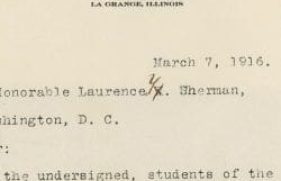
Letter from Lyons Township High School Students Supporting Keating-Owen Child Labor Bill
The Emergence of Modern America (1890-1930)
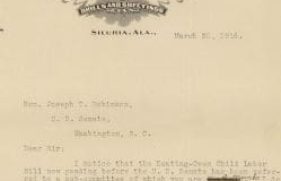
Letter from Marshall Dilling Opposing Keating-Owen Child Labor Bill
The Emergence of Modern America (1890-1930)
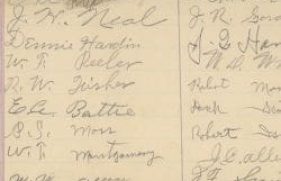
Letter from Operatives of Cherokee Falls Manufacturing Company Cotton Mill in Opposition to Keating-Owen Child Labor Bill
The Emergence of Modern America (1890-1930)