


Juneteenth General Order

Analyzing Documents
Share to Google Classroom
Recommended Activity
Published By:
National Archives Foundation
Historical Era:
Civil War and Reconstruction (1850-1877)
Thinking Skill:
Historical Analysis & Interpretation
Bloom’s Taxonomy:
Analyzing
Grade Level:
Middle School
Suggested Teaching Instructions
This activity is appropriate as a conclusion to the Civil War and the beginning of Reconstruction. For grades 5-12. Approximate time needed is 20 minutes.
It can be done individually, in pairs, or as a full class. Direct students to begin by taking a minute to examine the document, then responding to the questions.
They should proceed to answer the questions that follow, which will guide them through the process of written document analysis:
- Meet the document.
- Observe its parts.
- Try to make sense of it.
- Use it as historical evidence.
If necessary, check in with your students at each step in the process and model analysis if required.
After students have analyzed the document, direct them to the “When You’re Done” tab to answer the following questions:
Juneteenth became a federal holiday in June 2021 after Congress passed the Juneteenth National Independence Day Act and President Joe Biden signed it into law.
- Why do you think Congress wanted to make Juneteenth a national holiday?
- What does this date represent in American history?
- What do you think influenced lawmakers?
As a class, discuss the significance of this communication: that these were the last people to be informed that all formerly enslaved persons were now free. Share the following contextual information from the full document detail page as part of the discussion:
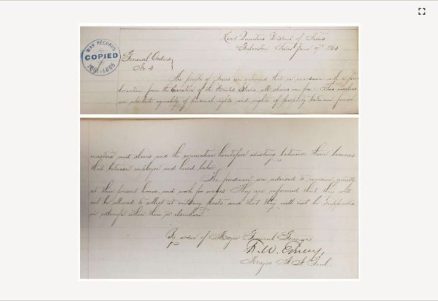
On June 19, 1865, two and a half years after President Abraham Lincoln’s historic Emancipation Proclamation, U.S. Maj. Gen. Gordon Granger issued General Order No. 3, which informed the people of Texas that all enslaved people were now free. Granger commanded the Headquarters District of Texas, and his troops had arrived in Galveston the previous day.
This order represents the Federal Government’s final execution and fulfillment of the terms of the Emancipation Proclamation. The people to whom this order was addressed were the last group of Americans to be informed that all formerly enslaved persons were now free.
The effects of this order would later be celebrated as the “Juneteenth” holiday, a combination of June and nineteenth. It is also called Freedom Day or Emancipation Day, and it is the oldest known celebration commemorating the end of slavery in the United States.

To the extent possible under law, National Archives Foundation has waived all copyright and related or neighboring rights to “Juneteenth General Order”
Description
In this activity, students will carefully analyze General Order 3 from Major General Gordon Granger which informed the people of Texas that “all slaves are free.”