

Issues with the Electoral College System

Making Connections
Share to Google Classroom
Recommended Activity
Published By:
National Archives Foundation
Historical Era:
Across Eras: Civics & Government
Thinking Skill:
Historical Issues-Analysis & Decision-Making
Bloom’s Taxonomy:
Creating
Grade Level:
High School
Suggested Teaching Instructions
Use this activity when studying the Electoral College system in a U.S. Government or Civics course for grades 9-12, or in an introductory college-level course. The approximate time needed to complete the activity as a full-class, in small groups, or as a “flipped classroom” assignment is 60 minutes.
Begin by discussing the history of the Electoral College—remind students of the many compromises of the Constitution and how often two competing interests resulted in the creation of a new system.
Ask students to begin the activity. They will be presented with several primary sources in the following segments.
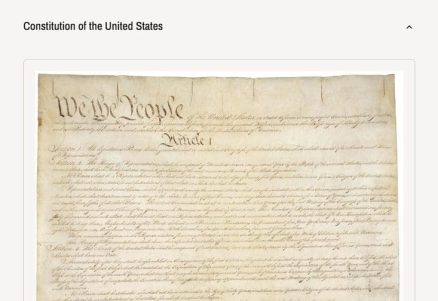
Items 1-6 – The Constitution and the first Election: Students will begin by reviewing the provisions of Article II, Section 1 of the U.S. Constitution establishing the Electoral College and detailing its process. Each passage from the Constitution is followed by a question that directs students to apply the passage to the next document or consider it in terms of their own state.
Items 7-11 – The Election of 1800: Direct students to examine the 1800 Electoral College tally and compare it to the tally from the first election. Students will notice that Thomas Jefferson and Aaron Burr both receive 73 votes. The next item is the Constitutional Provision from Article II, Section 1. Students are asked to complete the blank box with the first of four issues with the system.
Answer / Issue #1 — When there is no clear victor in the Electoral College, the President is selected by the House of Representatives.
- You can lead students in a discussion as to why this is less democratic and perhaps a flaw. Each state delegation has one vote and it is up to the individual states to determine how to vote. This disregards the people’s votes in their states, and upsets the balance of power among the three branches of government when the legislative branch chooses the executive (which is why the Framers did not want Congress to vote for the President originally). You can also discuss why the Framers felt this provision was necessary to add – to provide a back-up plan ensuring that there could not be a tie, preventing complications that a tie would cause.)
Items 12-14 – The 12th Amendment: Students will then examine the Joint Resolution proposing the 12th Amendment which allows for separate balloting in the Electoral College for President and Vice President. Using knowledge about the election of 1800, students will analyze the necessity for the 12th Amendment.
- You can discuss how the contentious election of 1800 between John Adams and Thomas Jefferson actually resulted in a tie between Thomas Jefferson and his own running mate, Aaron Burr. The Constitution did not distinguish between President and Vice-President in the votes cast by each state’s electors—it simply said the top vote-getter became President; the second Vice-President. This also meant that President and Vice President could come from separate tickets and two different political parties. The 12th Amendment changed the process so that the second-place Presidential finisher didn’t end up as the Vice President.
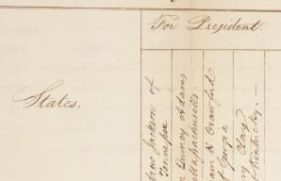
Items 15-18 – The Election of 1824: Students are to answer the questions that pertain to the number of electoral votes needed to win a simple majority. Today that number is 270, but at the time of the 1824 election only 131 were needed. As students examine the Electoral tally, they will note that Andrew Jackson received the most votes, 99, but not enough to clear the 131 needed. Students should recall from U.S. History the story of the “Corrupt Bargain.” Students are asked to identify and enter into the blank boxes the second and third issues with the electoral system.
Answer / Issue #2 — If there is no clear winner in the Electoral College, the House of Representatives selects the President.
Answer /Issue #3 — It is possible to win the popular vote and lose the Electoral College vote. (This has occurred five times in U.S. History: 1824, 1876, 1888, 2000, and 2016.)
- You can lead students in a discussion as to why this is considered a flaw by some, but why the Electoral College was designed this way. The Electoral College became part of the Constitution at the Constitutional Convention in Philadelphia in 1787, when delegates assembled to devise something to replace the Articles of Confederation. There was a concern that even qualified citizens (generally white, male landowners) wouldn’t have the information necessary to make a truly informed decision. Alexander Hamilton argued in favor of an Electoral College in Federalist Paper No. 68, with an opposing view coming from an anonymous source in Federalist Paper No. 72. (You can find both online at Yale’s Avalon Project.) The Founders decided to give the States the authority to appoint educated, well-read electors to vote on behalf of their citizens. Each state gets one elector for each member of its congressional delegation, and the District of Columbia gets as many as the least populous state (currently three), which makes a total of 538 electors. A candidate needs 270 votes to become President.
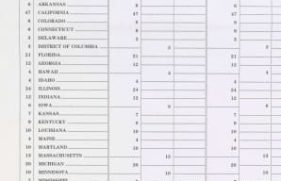
Items 19-21 – The Election of 1988: Direct students to examine the 1988 Electoral College tally and focus on the bottom portion of the document that discusses the results. They should note that an elector defected or was “faithless” – meaning they switched their vote for Dukakis and Bentsen (she did so in protest of this issue). This is the fourth issue that students should enter into the blank box.
Answer /Issue #4 — Electors do not have to vote as they promised the state and can defect.
- You may wish to discuss “faithless” electors in detail. Some states require electors to vote for the candidate they’ve pledged to support. Other states do not have this requirement, and electors can vote for anyone they want, even if they’ve pledged to vote for a particular candidate. Almost all electors have voted for the Presidential and Vice Presidential candidates that they were supposed to, however.
Items 22-25 – Proposals to fix the Electoral College: Students will then examine two documents that propose altering the Constitution to fix the issues with the Electoral College system and analyze each proposal for effectiveness (answers will vary). The first is an 1844 Joint Resolution proposing an interesting system of selecting the President by lot using balls. The second is a 1969 letter from Massachusetts proposing an Amendment to abolish the Electoral College.
Direct students to conclude the activity by completing the writing prompts in the “When You’re Done” section. They will be asked to reflect on the reform proposals and the lack of change to the Electoral College system:
Research the five predominate proposals to change the Electoral College:
- the district plan
- proportional plan
- national bonus plan
- direct election plan
- National Popular Vote Interstate Compact Plan
- Do you think the Electoral College should be abolished or changed? Why or why not?
- If it was modified, which proposal do you think is best? Write a 5 sentence argument advocating for which proposal you think is best. Rationalize your answer and consider the negatives.
The last question is adapted from the 2007 AP Government Exam.

To the extent possible under law, National Archives Foundation has waived all copyright and related or neighboring rights to “Issues with the Electoral College System”
Description
In this activity, students will trace the history of the Electoral College through analysis of primary source documents from the elections of 1789, 1800, 1824, and 1988. They will identify four issues with the system that could be perceived as “flaws,” some of which have been addressed and changed. An examination of proposed and implemented reforms, including the 12th Amendment, will engage students in a discussion of modifying or abolishing the Electoral College.
Share this activity with your students
Documents in this Activity

House Joint Resolution Proposing a Constitutional Amendment to Elect the President by Lot
Expansion and Reform (1801-1861)
1988 Presidential Election Electoral College Tally
Contemporary United States (1968 to the present)
Tally of the 1824 Electoral College Vote
Expansion and Reform (1801-1861)