

Immigration to America: Stories and Travels

Seeing the Big Picture
Share to Google Classroom
Recommended Activity
Published By:
National Archives Foundation
Historical Era:
Across Historical Eras
Thinking Skill:
Historical Analysis & Interpretation
Bloom’s Taxonomy:
Analyzing
Grade Level:
Middle School, High School
Suggested Teaching Instructions
Use this activity during a unit on immigration or geography. Students can work individually, or in pairs or small groups. For grades 7-12. Approximate time needed is 30 minutes.
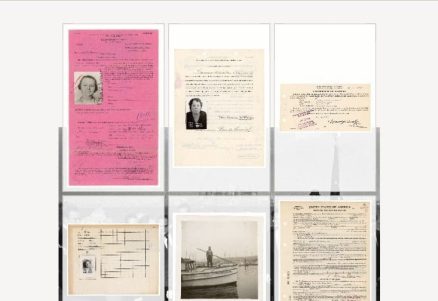
Begin in a full-class setting by discussing the fact that U.S. immigration policies have changed over the course of history. Project the activity for the entire class and choose one document from the grid with which to model document analysis. Define an immigration “push factor” versus “pull factor,” and brainstorm examples of each as a class.
Next, ask students to begin the activity. They will learn that millions of people immigrated to the United States from the 1880s through World War II, and that their stories were captured in documents and photographs attached to government forms in immigration case files.
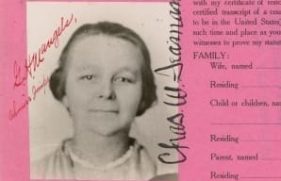
Students should analyze the six different documents and photographs in the grid, each representing one person. They will gather information to decipher why each person was in the United States – whether they were an immigrant from a foreign country, or were born in America, as in one case. Remind students to click on the “Open in New Window” icons to learn more about each person.
Students should then match each document to the reason why that person was in the United States. As they work, they should note whether each person’s reason was a pull factor or a push factor.
After students match each document to a reason, they will see a photograph of President Lyndon B. Johnson signing the Immigration and Nationality Act of 1965. Share with students that this act represented a significant change in American immigration policies because it eliminated the national origins quota system that had been in place since 1924.
When students click on “When You’re Done,” they will be prompted to make a list of what countries these people came from, when they came to the United States, and whether their reason for coming was a push or pull factor.
They will also see a link to a map, on which they can “follow” the movements of these eventual Americans around the world. Students can click on the icons on the map in order of the person’s travels – each person is represented by a different color, or use the navigation bar to the left of the map to click through each person’s journey.
Throughout the course of the activity, students should determine that:
- Richard Arvay came from Austria in 1944 to escape religious persecution and genocide during the Holocaust. (push factor)
- Mary Yee was a native-born citizen who married a Chinese merchant, and was therefore declared a Chinese citizen because of the Expatriation Act of 1907. In 1922, the family traveled to China from Seattle. (neither push nor pull)
- Minezo Araki worked as a farmer and a fisherman in the United States for more than 30 years after immigrating from Japan in 1908. During World War II, he went from being an “alien” to being an “enemy alien” and was forcibly relocated during Japanese internment. (pull factor)
- Stephan Bondareff left Russia to escape political persecution after the Russian Civil War, since he had served in the White Russian Army that was defeated by the Red Army (Bolsheviks). In 1927 he crossed into the United States over the Mexican border. (push factor)
- Carmen Wienke came from the Philippines when she married a U.S. serviceman in 1919, then left the U.S. to return to the Philippines in 1936. She was detained on Angel Island and deported when she tried to return, but was eventually able to come into the country in 1945. (pull factor)
- Maria Garcia accompanied her husband, a Mexican government official, in 1918. Then in 1924, she returned to Mexico to get her visa and walk back across the border on foot. (pull factor)

To the extent possible under law, National Archives Foundation has waived all copyright and related or neighboring rights to “Immigration to America: Stories and Travels”
Description
In this activity, students will match primary sources to various reasons that individuals came to and were living in the United States. They will sort these reasons into “pull” or “push” factors.
When finished matching, students can use a map to follow each person on their journey around the world. Students will also engage with the geography of North America, Europe, Asia, and the Pacific as they visualize the distances these people traveled and where they landed.
Share this activity with your students
Documents in this Activity
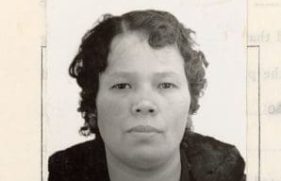
Authorization for Return of Carmen Wienke to Manila, Philippine Islands
The Great Depression and World War II (1929-1945)
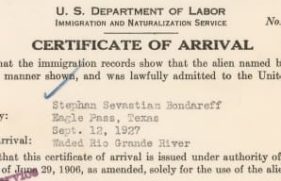
Certificate of Arrival for Stephan Sevestian Bondareff
The Emergence of Modern America (1890-1930)
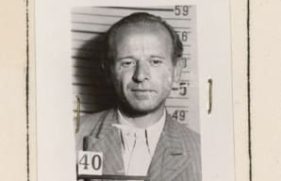
Richard Arvay's Identification Form
The Great Depression and World War II (1929-1945)