


How Have Americans Responded to Immigration?

Weighing the Evidence
Share to Google Classroom

Recommended Activity
Published By:
National Archives Foundation
Historical Era:
Across Historical Eras
Thinking Skill:
Historical Issues-Analysis & Decision-Making
Bloom’s Taxonomy:
Evaluating
Grade Level:
Middle School, High School
Suggested Teaching Instructions
This activity can be used to explore the topic of immigration with students. With documents spanning the 19th and 20th centuries, this activity may serve as a “past to prologue” exercise before discussing the current events surrounding immigration. This activity can be completed in class, in small groups, in pairs, individually, or assigned as homework. Designed for students in grades 6–12. The approximate time needed is 50 minutes.
Opener: Read an excerpt of the famous Emma Lazarus sonnet “The New Colossus,” which is found at the base of the Statue of Liberty, out loud:
“Give me your tired, your poor,
Your huddled masses yearning to breathe free,
The wretched refuse of your teeming shore.
Send these, the homeless, tempest-tost to me,
I lift my lamp beside the golden door!”
Ask students to think about and consider:
- How have immigrants been treated in America?
- How have Americans responded to immigration?
- Is America the land of opportunity for immigrants? Should it be?
Encourage students to keep these questions and their first reactions in mind as they complete this activity and analyze documents from the past.
Open the activity and select one of the documents. Model careful document analysis, ending with the question How did Americans respond to immigration? based on this document. Demonstrate how the scale works and ask students to place the document they just examined on the scale according to the interpretation it best supports: either America welcomes new immigrants and opens her doors to them, or America is fearful or skeptical of new immigrants and tries to exclude them.
Explain to the students that they will need to place each photograph and textual record on the scale based on careful document analysis.
After students complete the activity, they should click on the “When You’re Done” tab and answer the questions listed. Conduct a class discussion based on the students’ answers from the document analysis.
Students might note that American attitudes toward immigration have become more balanced based on the documents. For example, the Chinese-Exclusion Act and the Immigration Quotas of 1924, which were based on country of origin, have been eliminated. Students may suggest that the United States welcomed immigrants when their labor was needed or when the conditions in their home country were terrible.
Students may also mention that Americans seemed more welcoming when they thought immigrants could become good citizens. On the other hand, students will probably note that immigrants were feared when our country was economically struggling—when jobs were in short supply (or perceived to be) or when the United States was at war with an immigrant’s country of origin.
This activity borrowed several documents and modified the central question from educator Gary Colletti’s Immigration: Liberty’s promise fulfilled?

To the extent possible under law, National Archives Foundation has waived all copyright and related or neighboring rights to “How Have Americans Responded to Immigration?”
Description
In this activity, students will analyze documents related to immigration in the United States. Then they will determine whether immigration was welcomed or feared by Americans, and to what degree, by placing each document on the scale according to their analysis.
Share this activity with your students
Documents in this Activity

Foreign-Born Friends who are Applicants for American Citizenship
The Emergence of Modern America (1890-1930)
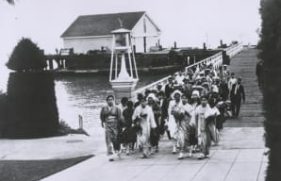
Immigrants Arriving at the Immigration Station on Angel Island
The Emergence of Modern America (1890-1930)
Incident Memorandum Regarding Cuban Refugees, Southern Florida
Contemporary United States (1968 to the present)