

From Slavery to Juneteenth: Emancipation and Ending Enslavement

Finding a Sequence
Share to Google Classroom

Recommended Activity
Published By:
National Archives Foundation
Historical Era:
Across Historical Eras
Thinking Skill:
Historical Comprehension
Bloom’s Taxonomy:
Evaluating
Grade Level:
High School
Suggested Teaching Instructions
This activity can be used as a review at the end of a unit of study on the Civil War era. It can also be used as an assessment tool. Students can work independently or in groups. The activity is appropriate for grades 8-12. Approximate time needed is 120 minutes.
Open the activity in front of the class and choose one of the documents. Model document analysis. Discuss the following:
- Identify the type of document.
- What are some unique characteristics?
- Identify the date and author(s).
- Speculate for whom it was written, its content, and why it was created.
If necessary, share the following historical context:
From its beginnings in the the 16th and 17th centuries through its abolition with the ratification of the 13th Amendment on December 6, 1865, millions of enslaved people toiled for hundreds of years throughout the United States.
Though it never mentioned the words slave or slavery by name, the U.S. Constitution protected and strengthened the institution by giving increased power to the Southern slave-owning states. In its infamous Three-Fifths clause, “all other persons” (i.e. slaves) were counted as 3/5s of a person for purposes of representation in Congress–inflating the South’s political power.
As the United States expanded west with the Louisiana Purchase and following the Mexican-American War, the slavery also spread west. Though Congress banned the importation of enslaved people in 1808, the domestic slave trade continued and grew during the 19th century. At the same time, a burgeoning abolitionist movement and a continued resistance from enslaved people pushed for the end of slavery.
Direct students to continue working through the activity individually, in pairs or in small groups. They should briefly read through each primary source and analyze each document, noting the specific dates for each. Students should then place the documents in chronological order.
As students analyze, students should discuss whether the document represents a step forward towards emancipation or a step backward towards continued slavery. Ask students to explain the strengths and weaknesses of some of the steps forward and backward (e.g. the DC Emancipation Act only applying to DC; the Emancipation Proclamation only applied to areas in open rebellion, etc).
The correct order for the sources is:
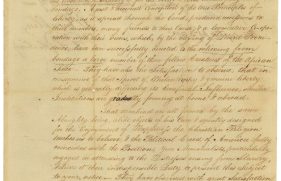
- Letter from Benjamin Franklin to Vice President John Adams with Petition from the Pennsylvania Society for Promoting the Abolition of Slavery (2/1790)
- Fugitive Slave Act of 1793 (2/12/1793)
- Petition Against the Slave Trade (12/30/1799)
- Act Prohibiting the Importation of Slaves (3/2/1807)
- Bill of Sale for Slave Named George (1833)
- Anti-Slavery Petition from the Women of Philadelphia (1844)
- The Compromise of 1850 (1/29/1850)
- Petition from Citizens of New York Asking that Slavery and the Slave-trade may be Expressly Prohibited by Act of Congress in all the Territories of the United States (3/25/1851)
- Kansas-Nebraska Act of 1854 (5/30/1854)
- Judgment in the U.S. Supreme Court Case Dred Scott v. John F. A. Sandford (3/6/1857)
- House Joint Resolution Proposing an Amendment to Prohibit Congress from Abolishing Slavery (3/2/1861)
- Newspaper Advertisement in the “True Democrat” for Runaway Slaves (ca. 1862)
- Lincoln’s Recommendation for Gradual Emancipation (3/6/1862)
- DC Emancipation Act (4/16/1862)
- Presidential Proclamation 90 by President Abraham Lincoln Revoking General David Hunter’s Order of Military Emancipation (5/19/1862)
- Emancipation Proclamation (1/1/1863)
- U.S. Brigadier General R. H. Milroy’s Order to Citizens of Winchester and Frederick County, Virginia in Reference to the Emancipation Proclamation of President Abraham Lincoln (1/5/1863)
- Circular Entitled Colored Soldiers! Equal State Rights! And Monthly Pay with White Men! (12/15/1863)
- Joint Resolution Proposing the Thirteenth Amendment (1/31/1865)
- General Order No. 3 (Juneteenth General Order) (6/19/1865)
After the students complete the sequencing of the sources, they should click on “When You’re Done.” Direct students to write 1-3 paragraphs about the key events that led to the end of slavery. Students should include details about several of the documents included in this activity and explain how each played a role in ending slavery. Students should note in their answers which documents represent steps forward towards emancipation and/or backward towards strengthening slavery.

To the extent possible under law, National Archives Foundation has waived all copyright and related or neighboring rights to “From Slavery to Juneteenth: Emancipation and Ending Enslavement”
Description
In this activity, students sequence key events related to both the expansion of slavery and the emancipation of enslaved people by placing documents in chronological order.
Documents were chosen to call attention to the struggle’s length, the steps forward and back, and the variety of people (from enslaved people themselves to abolitionists and politicians) who played a role in ending the institution of slavery.
Share this activity with your students
Documents in this Activity

Fugitive Slave Act of 1793
Revolution and the New Nation (1754-1820s)

Petition Against the Slave Trade
Revolution and the New Nation (1754-1820s)
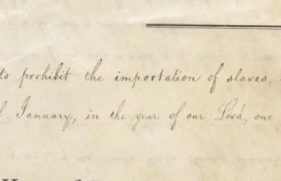
Act Prohibiting the Importation of Slaves
Revolution and the New Nation (1754-1820s)