

Facts Submitted to a Candid World: A Close Reading of the Declaration

Making Connections
Share to Google Classroom
Recommended Activity
Published By:
National Archives Foundation
Historical Era:
Revolution and the New Nation (1754-1820s)
Thinking Skill:
Historical Analysis & Interpretation
Bloom’s Taxonomy:
Analyzing
Grade Level:
Middle School
Suggested Teaching Instructions
This activity can be used during a unit on the American Revolution, the Declaration of Independence, or while exploring key American ideals and values from our Founding documents. For grades 6-8. Approximate time needed is 45-60 minutes. Students can complete the activity individually, in pairs, or in small groups.
Begin the activity by asking students what they already know about the American Revolution in general and the Declaration of Independence specifically. Ask students to take 60 seconds to brainstorm people, places, events, and concepts they associate with these terms in small groups or pairs.
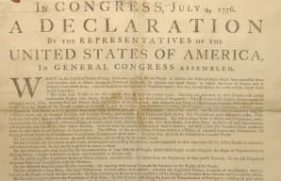
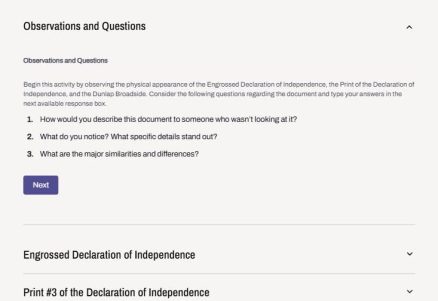
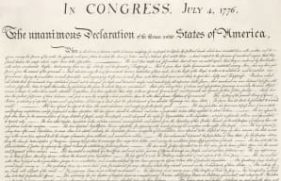
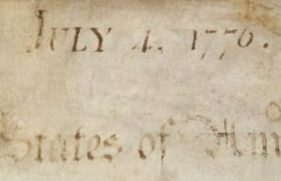
After discussing their ideas as a class, introduce the activity. Inform students that they will be doing a close reading of the Declaration of Independence, paying particular attention to the Preamble and the list of specific grievances. But first they will be looking at the Engrossed Declaration of Independence and a Print of the Declaration of Independence as an object/artifact. Tell students to focus on the following questions and answer in the next available blank response box:
- How would you describe this document to someone who wasn’t looking at it?
- What do you notice? What specific details stand out?
- What are the major similarities and differences?
After sharing their observations, tell students they are now going to analyze the language of the Declaration of Independence as a persuasive argument. They will be looking at short sections of the document. Model analyzing the Declaration of Independence by focusing attention on the first selection as a class. Following this whole class discussion, the rest of the activity can be completed individually, in pairs, or in small groups and/or as a jigsaw activity where different students explore an individual section of the document. Direct students to answer the following questions in the next available blank response box:
- How did the authors use language to persuade people to support their case for independence?
- What are some specific examples of words or phrases used to influence people to support their case for independence?
After reading the selections, ask students to enter their answer in the blank text box that follows, or to conduct a turn-and-talk with a partner to share their phrase and word selections and explain why they were chosen. Ask students to volunteer their phrase and word selections, with explanations, for the rest of the class. As students share, ask if other students selected the same phrase or word, and facilitate a conversation about the reasons why specific phrases and words were selected.
Direct students to selections from the list of grievances included in the Declaration of Independence. Inform students that they will be analyzing examples of grievances, looking for persuasive language, and consider how the complaints could be reworded in a more neutral way. Direct students to answer the following questions in the next available blank response box:
- What specific words might have been chosen to appeal to people’s emotions?
- How could these grievances be stated in a more neutral way?
After completing the activity, students should click on “When You’re Done” and answer the following:
- Which argument and appeal did you find most convincing? Why?
- Which specific grievances do you feel were most convincing? Why?
- What specific words or phrases stand out in the Declaration of Independence? How have these phrases shaped American values and ideals?
Share the following historical context, if necessary:
In the early 1770s, more and more colonists became convinced that Parliament intended to take away their freedom. In fact, the Americans saw a pattern of increasing oppression and corruption happening all around the world. Parliament was determined to bring its unruly American subjects to heel. Britain began to prepare for war in early 1775. The first fighting broke out in April in Massachusetts. In August, the King declared the colonists “in a state of open and avowed rebellion.” For the first time, many colonists began to seriously consider cutting ties with Britain. The publication of Thomas Paine’s stirring pamphlet Common Sense in early 1776 lit a fire under this previously unthinkable idea. The movement for independence was now in full swing.
The colonists elected delegates to attend a Continental Congress that eventually became the governing body of the union during the Revolution. Its second meeting convened in Philadelphia in 1775. The delegates to Congress adopted strict rules of secrecy to protect the cause of American liberty and their own lives. In less than a year, most of the delegates abandoned hope of reconciliation with Britain. On June 7, 1776, Richard Henry Lee introduced a resolution “that these united colonies are and of right ought to be free and independent states.” They appointed a Committee of Five to write an announcement explaining the reasons for independence. Thomas Jefferson, who chaired the committee and had established himself as a bold and talented political writer, wrote the first draft.
On June 11, 1776, Jefferson holed up in his Philadelphia boarding house and began to write. He borrowed freely from existing documents like the Virginia Declaration of Rights and incorporated accepted ideals of the Enlightenment. Jefferson later explained that “he was not striving for originality of principal or sentiment.” Instead, he hoped his words served as an “expression of the American mind.” Less than three weeks after he’d begun, he presented his draft to Congress. He was not pleased when Congress “mangled” his composition by cutting and changing much of his carefully chosen wording. He was especially sorry they removed the part blaming King George III for the slave trade, although he knew the time wasn’t right to deal with the issue.
On July 2, 1776, Congress voted to declare independence. Two days later, it ratified the text of the Declaration. John Dunlap, official printer to Congress, worked through the night to set the Declaration in type and print approximately 200 copies. These copies, known as the Dunlap Broadsides, were sent to various committees, assemblies, and commanders of the Continental troops. The Dunlap Broadsides weren’t signed, but John Hancock’s name appears in large type at the bottom. One copy crossed the Atlantic, reaching King George III months later. The official British response scolded the “misguided Americans” and “their extravagant and inadmissable Claim of Independency.”
For additional materials related to Facts Submitted to a Candid World: A Close Reading of the Declaration (including Guiding Questions, National Standards, Historical Background and Supplemental Educational Resources).

To the extent possible under law, National Archives Foundation has waived all copyright and related or neighboring rights to “Facts Submitted to a Candid World: A Close Reading of the Declaration”
Description
In this activity, middle school students will explore the Declaration of Independence through a close reading. They will explore the different versions and sections of the Declaration of Independence with particular attention paid to the Preamble and the selections from the list of grievances.
Share this activity with your students
Documents in this Activity
Print of the Declaration of Independence
Expansion and Reform (1801-1861)
The Declaration of Independence
Revolution and the New Nation (1754-1820s)