

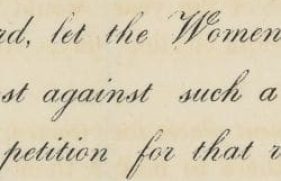
Extending Suffrage to Women

Finding a Sequence
Share to Google Classroom
Recommended Activity
Published By:
National Archives Foundation
Historical Era:
The Emergence of Modern America (1890-1930)
Thinking Skill:
Chronological Thinking
Bloom’s Taxonomy:
Analyzing
Grade Level:
Middle School, High School
Suggested Teaching Instructions
Learning Objectives
Students will analyze and understand primary sources in context; recognize the length of the struggle; identify the movement’s methods; understand that there were many arguments for and against woman suffrage, and that the arguments used by both sides were in some cases very similar. For grades 7-12. Approximate time needed is 50 minutes.
Instructions
Students should be familiar with the term “suffrage,” the 15th and 19th Amendments, and the names “Susan B. Anthony” and “Elizabeth Cady Stanton.”
Open the activity in front of the class and choose the 1869 document “Joint Resolution Proposing the 15th Amendment to the U.S. Constitution.” Model document analysis. Identify the type of document. After recognizing it as a Congressional document, point out unique characteristics. Identify the date and author(s). Speculate for whom it was written, its content, and why it was created. Put its aim and impact into plain language for students.
Ask the class to speculate why an activity about woman suffrage would include a document that gave African American men the right to vote. Students may hypothesize that African American male suffrage sparked the woman suffrage movement. Clarify that while it intensified following the 15th Amendment, the struggle for women’s rights had begun earlier. Ask students why they think gender was not included in the list of “race, color, or previous condition of servitude” for which citizens could not be excluded from voting. Explain that leading up to and following passage of the 15th Amendment, advocates of woman suffrage urged that women to get the right to vote alongside African American men.
Post a timeline of major events that occurred between 1865 and 1920 for student reference. Include:
- 1862 Homestead Act passed
- 1865 Civil War ended
- 1869 Transcontinental Railroad completed
- 1870 African American men could vote
- 1882 Thomas Edison installed electric lights in New York City
- 1892 Ellis Island opened
- 1898 Spanish American War fought
- 1918 World War I ended
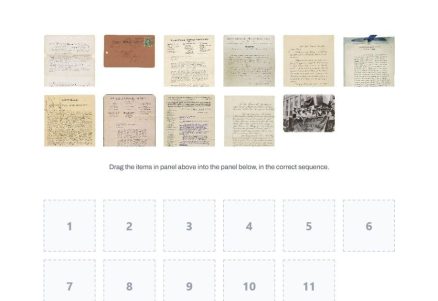
Ask student pairs to open the activity and sequence the documents. Instruct them to analyze each document before moving any. Ask them to make a list of arguments made for and against woman suffrage as they complete the activity.
When students have finished, note the methods or strategies used to fight for woman suffrage, including: civil disobedience, petitions and memorials, letter-writing campaigns, and direct communication with government officials.
Ask students to share and compare their lists of arguments for and against the right to vote. Lists could include:
For:
- Women, as citizens, should already have the vote per the Constitution.
- Women serve their country, pay taxes and deserve representation.
- The time is now: the wait has been too long; women are integral to the country.
- There is nationwide support; data supports this.
Against:
- This is not the time: the African American man’s vote is the priority.
- This is not the time: The country is in the middle of WWI.
- The issue has already been decided in the states and data supports this.
- A federal amendment would trample states rights; the Constitution reserves this power for the states.
- Suffragists want to shortcut governmental procedure and force change by pressuring politicians.
Refer to the time line and discuss how long it took to win suffrage. Note the documents urging a 16th amendment for woman suffrage and the eventual 19th Amendment. Ask:
- Which arguments tended to be brought up closer to the beginning of the movement and which toward the end?
- Which were most effective and why?
- How do you think the leaders of this movement changed as the struggle went on?

To the extent possible under law, National Archives Foundation has waived all copyright and related or neighboring rights to “Extending Suffrage to Women”
Description
In this activity, students will analyze documents pertaining to the woman suffrage movement as it intensified following passage of the 15th Amendment that guaranteed the right to vote for African American males. Documents were chosen to call attention to the struggle’s length, the movement’s techniques, and the variety of arguments for and against giving women the vote.
Share this activity with your students
Documents in this Activity
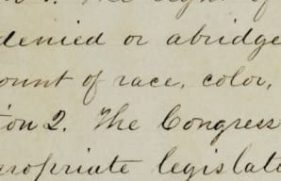
Joint Resolution Proposing the Fifteenth Amendment
Civil War and Reconstruction (1850-1877)
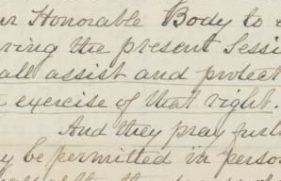
Letter to Congress from Elizabeth Cady Stanton, Susan B. Anthony and Others in Support of Women's Suffrage
The Development of the Industrial United States (1870-1900)

Record of Conviction in U.S. vs. Susan B. Anthony
The Development of the Industrial United States (1870-1900)