

Exploring Treaties: Navajo Treaty of 1868

Seeing the Big Picture
Share to Google Classroom
Recommended Activity
Published By:
National Archives Foundation
Historical Era:
Civil War and Reconstruction (1850-1877)
Thinking Skill:
Historical Analysis & Interpretation
Bloom’s Taxonomy:
Analyzing
Grade Level:
Lower Elementary
Suggested Teaching Instructions
This activity can be used in an American history class to discuss Native Americans, rights, and treaties. The activity is designed to be completed as a full class activity. For grades K-2. Estimated time: 30 minutes.
Ask the students if they have ever made a promise to someone before? What are some different ways that you could make a promise? Answers may include: verbally, shake hands, pinky promise, write it down, a ceremony. Ask students why it is important to keep promises. How do the students feel when a promise is kept? How do they feel when a promise is broken?
Introduce the definition of a treaty to students.
- Treaty is a promise, or formal agreement, between nations.
- Treaties are more formal promises and they could be with a different group who have different ideas or interests that may be harder to agree upon.
- Treaties require negotiation or discussions to reach an agreement.
A treaty is a formal agreement or a promise that is written down between nations. Just like you do with the promises you make—in a treaty, both parties have obligations—or things they agree to do, or promise.
Throughout our history, the United States has made a variety of agreements with other nations leading to the end of wars, land transfers, trade, etc. And while many agreements were made with countries around the world (e.g. Great Britain at the end of the American Revolution), the US government has also made agreements through treaties with Native Nations, or specific Native American groups throughout what is now the United States. Many of the agreements in treaties between Native Nations and the American Government were not honored.
Explain to students that you are going to look at examples of agreements that were made in The Treaty Between the United States Government and the Navajo. This was the last in a series of treaties between the Navajo and the United States. Leaders representing both the Navajo and the United States met to negotiate the terms of this treaty. Each group tried to have the details of the treaty best serve the needs of their community.
This treaty made several different agreements between the Navajo Nation and the United States Government.
Some of these agreements included:
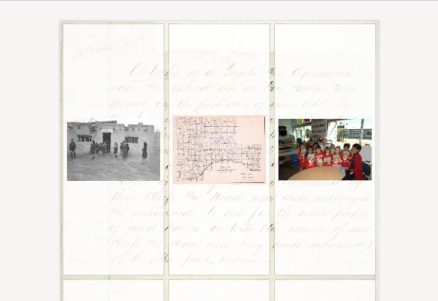
- land was set apart for the Navajo Reservation
- schools would be provided for Navajo children
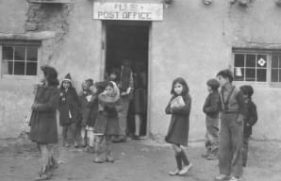
- works of utility such as post offices and roads can be constructed on the land
The documents shown represent these agreements. As a class, look closely at these documents and see if you can match them with the phrase from the Treaty. Once the matches have been made, the students will see the first page of the treaty.
Explain to students that before this treaty, the Navajo had been forced to leave their homeland. The agreements negotiated in this treaty allowed the Navajo to return to their home by designating part of their homeland as the Navajo reservation (or land reserved for a tribe). One of the promises of the treaty included Navajo sovereignty—that meant that the Navajo are in charge of their land. The Navajo Nation is a sovereign nation which can govern itself and control their own interests.
Ask students to consider the ideals of the Declaration of Independence. Explain that the Declaration of Independence also included the concept of sovereignty—the United States government is founded upon the idea that its power comes from the people. Throughout history individuals have demonstrated this power by speaking up for the best interests of their communities. Lead a class discussion that helps the students reflect on how this idea may connect to the treaty they just analyzed.

To the extent possible under law, National Archives Foundation has waived all copyright and related or neighboring rights to “Exploring Treaties: Navajo Treaty of 1868”
Description
In this activity, lower elementary school students will connect documents with agreements made as part of the Treaty Between the United States Government and the Navajo, 1868.
Share this activity with your students
Documents in this Activity

Part of the Navajo Indian Reservation
Postwar United States (1945 to early 1970s)

Visit of Secretary Dirk Kempthorne to the Tuba City Boarding School
Contemporary United States (1968 to the present)

Treaty Between the United States Government and the Navajo
The Development of the Industrial United States (1870-1900)