

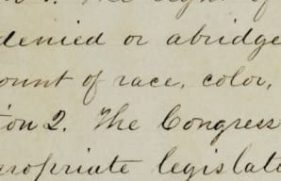
Expanding Suffrage: 15th Amendment and the Voting Rights Act

Compare and Contrast
Share to Google Classroom
Recommended Activity
Published By:
National Archives Foundation
Historical Era:
Across Historical Eras
Thinking Skill:
Historical Analysis & Interpretation
Bloom’s Taxonomy:
Analyzing
Grade Level:
High School
Suggested Teaching Instructions
This activity is appropriate in a unit related to the Civil War and Reconstruction, the Civil Rights movement, or in a Civics unit about the expansion of suffrage–the right to vote. For grades 9-12. Approximate time needed is 30 minutes.
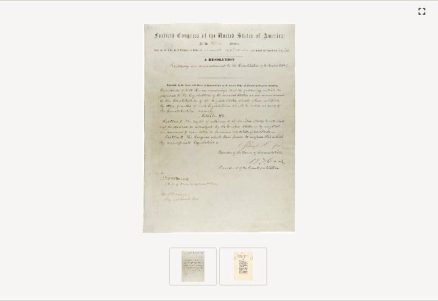
This activity can be completed individually or in small groups. Students can either work on analyzing both documents, or you can ask 1/2 of each class to analyze each document and then compare findings. Prompt students to carefully examine the two documents with the discussion questions provided. Remind them to click on the magnifying glass for further detail. Model document analysis with the 15th Amendment.
- What type of document is it?
- Describe it as if you were explaining to someone who can’t see it.
- Who wrote it?
- Who read/received it?
- When is it from?
- Where is it from?
- What is it talking about?
- Write one sentence summarizing this document.
- Why was it written? Quote evidence from the document that tells you this.
- What was happening at the time in history this document was created?
Discuss and chart details of the individual documents side-by-side. Ask students to compare certain details, especially the overall purpose of each document and the years between their creations.
- How are the documents related to each other? How do their purposes relate to each other?
- How far apart are the two documents?
- What was happening in each period of history?
- What was happening between these periods?
- What do these two documents tell you about US history?
Through this discussion, focus on details such as there are over 90 years between the two documents, one is a joint resolution proposing a constitutional Amendment that would have to be ratified by the states and the other is a law created to specifically enforce the 15th Amendment. They might also point to the fact that the 15th Amendment applied only to male suffrage, while the Voting Rights Act of 1965 (due to the intervening 19th amendment) applied to females as well. Students may also point to the Jim Crow laws, poll taxes, and literacy tests that existed between these two documents.
For additional materials related to Expanding Suffrage: 15th Amendment and the Voting Rights Act (including Guiding Questions, National Standards, Historical Background and Supplemental Educational Resources).

To the extent possible under law, National Archives Foundation has waived all copyright and related or neighboring rights to “Expanding Suffrage: 15th Amendment and the Voting Rights Act”
Description
In this activity, students will examine selections from the 15th Amendment that granted suffrage to former male slaves and the Voting Rights Act of 1965 nearly 100 years later that protected that right.
Share this activity with your students
Documents in this Activity

Voting Rights Act of 1965
Postwar United States (1945 to early 1970s)