

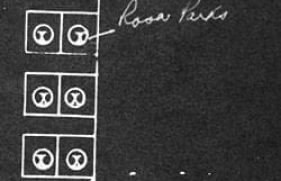
Examining Rosa Parks’s Arrest Record and Bus Diagram

White Out/Black Out
Share to Google Classroom

Recommended Activity
Published By:
National Archives Foundation
Historical Era:
Postwar United States (1945 to early 1970s)
Thinking Skill:
Historical Analysis & Interpretation
Bloom’s Taxonomy:
Applying
Grade Level:
Lower Elementary, Upper Elementary
Suggested Teaching Instructions
This activity can be used during a unit on the Civil Rights movement, in teaching about protests and civil disobedience, or when focusing on Rosa Parks individually. For grades grades 4-8. Approximate time needed is 20-30 minutes.
Most students have learned about Rosa Parks and the Civil Rights Movement: On December 1, 1955, Ms. Parks took part in a deliberate planned act of civil disobedience by refusing to relinquish her seat on a public bus for a White person.
Ask students to work in pairs to engage in conversation and share their thought processes. The activity asks students to: “Look carefully at these documents. They are part of a famous story, but important clues have been blacked out. Use every bit of information contained here to describe what you see. Then, apply your knowledge of history to figure out what these documents are and whom the story is about.”
Depending on students’ abilities and prior knowledge, assign 3-10 minutes to examine the evidence. Assign 3-5 minutes for students to write a description of the evidence, their thought process, and their conclusions. Then, ask each pair of students to report both their thinking and their answers to the class. Follow up with a review of the events related to Rosa Parks. Find more information about her arrest on the Teaching With Documents section of the National Archives website.
To conclude the activity, lead a discussion based on the follow-up questions in the “When You’re Done” section:
- These documents tell part of a famous story of a person, of a group of people, and of our country. It’s a big story of courage and audacity, and these documents provide the evidence of what really happened.
- What evidence was most helpful? What was confusing or surprising? What helped you discover whom this story is about?
- Look at other documents related to Rosa Parks and to the Civil Rights Movement. Tell the story of Ms. Rosa Parks using this document and others as the factual basis of your narrative.

To the extent possible under law, National Archives Foundation has waived all copyright and related or neighboring rights to “Examining Rosa Parks’s Arrest Record and Bus Diagram”
Description
This activity requires students to examine the arrest record and a diagram of an un-named person. Students will analyze and evaluate the data contained in the document, applying prior knowledge, to discern what happened in the incident and the identity of the person involved. It is Rosa Parks, but her name has been blacked out in the activity.
Share this activity with your students
Documents in this Activity
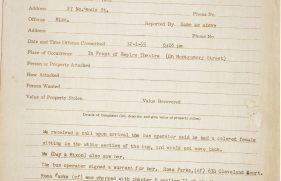
Police Report on Arrest of Rosa Parks
Postwar United States (1945 to early 1970s)