


Evaluating the New Departure Strategy in the Fight for Women’s Suffrage

Making Connections
Share to Google Classroom
Recommended Activity
Published By:
National Archives Foundation
Historical Era:
Civil War and Reconstruction (1850-1877)
Thinking Skill:
Historical Analysis & Interpretation
Bloom’s Taxonomy:
Evaluating
Grade Level:
High School
Suggested Teaching Instructions
This activity can be used in a U.S. history course while learning about women’s suffrage or voting rights. It is intended for grades 9-12. Approximate time needed is 45–60 minutes. Students can work individually or in small groups.
Ask students to begin the activity by reading the introduction and directions, then clicking through the activity. Remind them to click “View Document Details” for each document to view it more closely and access contextual information and transcripts.
Activity Overview: Each document is preceded by a question and followed by a text box where students can answer the question. Documents, questions and possible answers are:
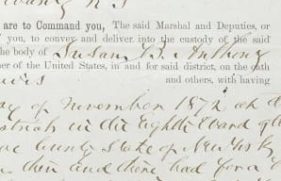
- Order to U.S. Marshal to Deliver Susan B. Anthony to County Jail
- Why was Susan B. Anthony arrested?
Susan B. Anthony was arrested for illegally voting on November 5, 1872 in Rochester New York.
- Why was Susan B. Anthony arrested?
- Hearing Transcript for U.S. vs. Susan B. Anthony Pages 7–8
- What explanation did Beverly Jones use for initially refusing Anthony’s request to register to vote?
The Constitution of the State of New York only gave the right to vote to male citizens. - According to Beverly Jones, what did Anthony use to justify her assertion that she should be permitted to register to vote? Did she persuade the election officials?
Under the Fourteenth Amendment of the Constitution of the United States, Anthony was a U.S. citizen and therefore had a right to vote. The election officials allowed Anthony to register to vote.
- What explanation did Beverly Jones use for initially refusing Anthony’s request to register to vote?
- Hearing Transcript for U.S. vs. Susan B. Anthony Pages 14–15
- According to Anthony’s testimony, why did she vote in the election?
- According to Anthony, she was advised by Judge Henry Selden that the only way to find out if she had the right to vote was to test it. Anthony also stated that not a particle of her doubted her right to vote.
- According to Anthony’s testimony, why did she vote in the election?
- Joint Resolution Proposing the Fourteenth Amendment Section 1
- Do you agree that the Fourteenth Amendment guarantees women the right to vote? Why or why not?
- Agree: According to Section 1 of the Fourteenth Amendment, all persons born or naturalized in the United States are citizens. Additionally, states are not permitted to “make or enforces laws which abridge the privileges or immunities of the United States.” According to this amendment, women are citizens of the United States. If you consider voting a right of citizenship, laws that disenfranchise women are unconstitutional.
- Disagree: While Section 1 of the Fourteenth Amendment says no state can “make or enforce laws which abridge the privileges or immunities of the United States,” it doesn’t explicitly state that voting is one of these privileges. Additionally, there were and are other limitations on voting, such as age, which means the right to vote is not necessarily an automatic right of citizenship, and therefore not protected by the Fourteenth Amendment.
- Do you agree that the Fourteenth Amendment guarantees women the right to vote? Why or why not?
- Susan B. Anthony Petition for Remission of Fine Imposed for Voting Pages 10–16
- Why did Anthony petition Congress?
- According to her petition, Susan B. Anthony wanted Congress to review her trial and excuse her fine because her trial was unjust. Anthony argued that while she cannot complain about the court’s decision regarding her right to vote, her conviction and fine were ultimately unjust because the judge instructed the jury to issue a guilty verdict without any deliberation. Anthony believed she was denied to her right to trial by jury.
- Why did Anthony petition Congress?
Teacher Note: Judge Hunt’s order to the jury to issue a guilty verdict was controversial at the time. A later Supreme Court decision (Sparf v. United States in 1895) would find that judges cannot do this.
Wrap-up: After students have finished reading the documents and responding to the questions, they will be instructed to review the following information and submit answers to a final set of questions in the “When You’re Done” section of the activity:
Congress did not remit Anthony’s fine. However, she never paid it. She was not sentenced to any jail time as a result of her trial or refusal to pay her fine.
In October 1872 Virginia Minor attempted to register to vote in St. Louis, Missouri. She was not allowed to register. Minor (with the help of her husband, since married women could not sue at this time in Missouri) went to court and her case made it to the Supreme Court. In Minor v. Happersett. The Supreme Court came to the unanimous opinion “that the Constitution of the United States does not confer the right of suffrage upon anyone, and that the constitutions and laws of the several States which commit the important trust to men alone are not necessarily void.” (Minor v. Happersett, 88 U.S. 162 (1875))
Questions: Reflect on the significance of the New Departure strategy. What did the ruling in Minor v. Happersett mean for this approach? What options did women have left to achieve the right to vote?
The Supreme Court ruling essentially doomed the New Departure strategy. The Court found that the Constitution did not automatically confer the right to vote upon citizens. States determine voting qualifications and state laws that limited voting to men were constitutional. A ruling from the Supreme Court closed the door on the argument that women already had the right to vote. Instead, women could focus on changing the law, whether it be changing voting qualifications at the state level to include women, or pursuing a constitutional amendment that would prohibit states from restricting voting on account of sex. The latter option would follow in the footsteps of the 15th Amendment that prohibited states from denying voting rights on the basis of race (although states would find ways to get around amendment in the decades that followed.)
Additional Discussion Questions
You may want to introduce the following prompts in a class discussion following the completion of the activity to help students make connections to the present:
- Were you surprised by the ruling in Minor v. Happersett?
- As we’ve seen, the courts did not view voting as a fundamental right of citizenship. How do we consider the right to vote today? Would you argue that it is fundamental? Why or why not?
Additional Resources
In addition to Susan B. Anthony, 14 other women were arrested for voting illegally in Rochester New York in 1872. The 14 women ranged in age from 31 to 74. Some were family members; some were longstanding advocates for civil rights. Susan B. Anthony’s partners in the fight for suffrage were Mary S. Anthony, Guelma Anthony McLean, and Hannah Anthony Mosher (three sisters of Susan B. Anthony); Charlotte Bowles Anthony (married to a distant cousin); Ellen S. Baker; Nancy M. Chapman; Hannah M. Chatfield; Jane M. Cogswell; Rhoda DeGarmo; Mary S. Hebard; Susan M. Hough; Margaret Garrigues Leyden; Mary E. Pulver; and Sarah Cole Truesdale. Explore additional documents sharing their story on DocsTeach here.
Susan B. Anthony was not the first woman to attempt to vote. Her story is a part of a much larger story of activists across the country testing their voting rights. Challenge students to conduct their own research into how women in your community fought for the right to vote.
The opinion from Minor v. Happersett is available at the Library of Congress.
This activity was adapted from the educational document resource “Our Mothers Before Us: Women and Democracy, 1789–1920,” a project of the Center for Legislative Archives.

To the extent possible under law, National Archives Foundation has waived all copyright and related or neighboring rights to “Evaluating the New Departure Strategy in the Fight for Women’s Suffrage”
Description
In this activity, students will evaluate the New Departure strategy of the women’s suffrage movement – the idea that the Constitution already guaranteed the right to vote for women, they just had to test it by voting – that was championed by the National Woman Suffrage Association.
Students will analyze documents from Susan B. Anthony’s arrest and trial for voting in the 1872 election. They will answer questions as they work through the documents and evaluate the claim that the Fourteenth Amendment enfranchised women.
Share this activity with your students
Documents in this Activity

Petition of Susan B. Anthony for Remission of Fine Imposed for Voting
The Development of the Industrial United States (1870-1900)
Order to U.S. Marshal to Deliver Susan B. Anthony to County Jail
The Development of the Industrial United States (1870-1900)

Hearing Transcript for U.S. vs. Susan B. Anthony
The Development of the Industrial United States (1870-1900)