


Equal Education: Compare and Contrast Photographs

Compare and Contrast
Share to Google Classroom

Recommended Activity
Published By:
National Archives Foundation
Historical Era:
Postwar United States (1945 to early 1970s)
Thinking Skill:
Historical Analysis & Interpretation
Bloom’s Taxonomy:
Analyzing
Grade Level:
Lower Elementary
Suggested Teaching Instructions
This activity could be used as part of a lesson related to civil rights or school desegregation. Students can complete the activity as a full class or in small groups. For grades K-2. Approximate time needed is 20 minutes.
Present the activity to the full class and explain that you are going to be looking carefully at four photographs to find details that help tell us information about the larger story.
Ask the students to look closely at these photographs from two different schools in Virginia: one from a school open to White children only, and the other from a school for Black children. These photographs were used as evidence in a 1948 court case that attempted to make sure that all students had equal educational opportunities. This court case, Alice Lorraine Ashley v School Board of Gloucester County, was a precursor to Brown v Board of Education.
Model document analysis with the students and observe the details in each photo:
- Meet the photo.
- What do you notice?
- What objects do you see?
- What is the same in each photograph?
- What is different in each photograph?
Conduct a full class discussion comparing and contrasting the four photographs.
Ask students:
- Do you think these photographs look equal? Why or why not?
- What do these photographs tell us about the schools where they were taken?
Explain to students that sometimes it takes many years of people using their voices and organizing to change a law, like the plaintiffs did through the courts.
With this in mind, ask students to consider the ideals of the Declaration of Independence, and particularly the phrase “all men are created equal.” Ask students to define “equal,” and ask what they think is the meaning of the phrase. Answers may include “everyone is treated the same,” “everyone has the same rights.”
Lead a class discussion that helps the students reflect on how the meaning of this phrase may connect to the photographs they just analyzed.
Share the following historical context, if necessary:
These photographs come from the court case Alice Lorraine Ashley v. School Board of Gloucester County. It was one of several cases that lawyers from the Virginia chapter of the National Association for the Advancement of Colored People (NAACP) brought to U.S. District Courts across Virginia to attempt to equalize educational opportunities for Black and White students. (Almost all of Virginia’s population at the time was recorded as either White or Black. According to Virginia’s “racial integrity laws,” enacted in 1924-1930, Whites were those with “no trace whatsoever of any blood other than Caucasian”; and all non-White students, including the small population of American Indians, were categorized as “colored” or Black.)
The plaintiffs entered these photograph as evidence in the case to show the unequal facilities at schools for White and Black students in Gloucester County, Virginia. The first image, submitted by the plaintiffs as Exhibit No. 42, shows the boys bathroom stall at the Gloucester Training High School (the school for Black students), which was a single stall located outside with no running water. The second photograph, submitted by the plaintiffs as Exhibit No. 28, shows a girls bathroom at Botetourt High School (the school for White students) with at least five private indoor stalls, a small vanity mirror, and running water.
Botetourt had central heating, central plumbing, and smaller class sizes. Gloucester Training School had outdoor bathrooms, no central heat, and overcrowded classrooms. The school district spent significantly more money in the White school than they did in the Black school. The average annual cost per student at Botetourt was $81.63, versus $51.49 at Gloucester Training High School.
Judge Charles Sterling Hutcheson, U.S. District Court Judge for the Eastern District of Virginia, ruled that the school district was discriminating against Black students and teachers and that school officials needed to equalize the schools. But he emphasized that the court would not be enforcing the ruling, so these schools continued to remain separate and unequal.
Cases like Alice Lorraine Ashley v. School Board of Gloucester County contributed to the NAACP’s larger national campaign – the “equalization strategy” – which aimed to erode White support for segregated schools by demonstrating the financial cost of funding separate-but-equal schools for both Black and White students.
Judge Hutcheson’s ruling demonstrated the shortcomings of the NAACP’s equalization strategy. He recognized that the school district was discriminating against Black students and teachers, but offered no solution or path forward to equity. He articulated the NAACP’s thesis that fulfilling the “separate but equal” doctrine would make it too costly for school districts to maintain separate and equal facilities, but the toothless ruling left it up to the school district to decide how to equalize.
After 1950, the NAACP abandoned the equalization strategy and filed lawsuits directly challenging the constitutionality of the “separate but equal” doctrine. One such case was Dorothy E. Davis, et al. v. County School Board of Prince Edward County, Virginia, one of the five cases combined into Brown v. Board of Education that ruled segregation in schools unconstitutional in 1954.
That Supreme Court decision signaled the end of legalized racial segregation in the schools of the United States, overruling the “separate but equal” principle set forth in the 1896 Plessy v. Ferguson case.
For additional materials related to Equal Education: Compare and Contrast Photographs (including Guiding Questions, National Standards, Historical Background and Supplemental Educational Resources).

To the extent possible under law, National Archives Foundation has waived all copyright and related or neighboring rights to “Equal Education: Compare and Contrast Photographs”
Description
This comparative analysis activity involves comparing and contrasting two photographs that were used as evidence in the court case Alice Lorraine Ashley v School Board of Gloucester County, one of several cases that lawyers from the Virginia chapter of the National Association for the Advancement of Colored People (NAACP) brought to U.S. District Courts across Virginia to attempt to equalize educational activities for Black and white students.
Share this activity with your students
Documents in this Activity

View of the Boys Bathroom at Gloucester Training School
Postwar United States (1945 to early 1970s)
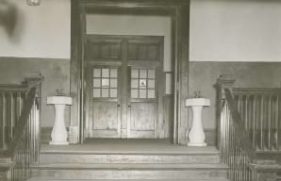
View of the Entrance to the Botetourt High School and Drinking Fountains
Postwar United States (1945 to early 1970s)

Drinking Fountain at the Gloucester Training School
Postwar United States (1945 to early 1970s)