

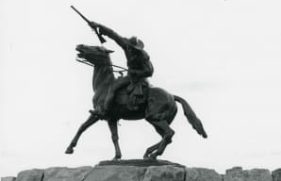
Debating Monuments, Memorials and Statues

Weighing the Evidence
Share to Google Classroom
Recommended Activity
Published By:
National Archives Foundation
Historical Era:
Across Historical Eras
Thinking Skill:
Historical Issues-Analysis & Decision-Making
Bloom’s Taxonomy:
Evaluating
Grade Level:
High School
Suggested Teaching Instructions
This activity can be used to explore the topic of memorializing historical figures. It can be completed in class (including in hybrid or all-remote settings), in small groups, in pairs, individually, or assigned as homework. Designed for students in grades 9-12. Approximate time needed is 80 minutes.
To begin, ask students to define the terms monument and memorial. After discussing definitions, ask students if they can think of a monument or memorial in their town, city, county, or state.
- What does the monument memorialize?
- Why do we memorialize people through sculptures?
Tell students to imagine that they have been appointed by Congress to a National Monument, Memorial, and Statue Taskforce that is asked to make recommendations in favor or against statues erected throughout the United States. The recommendations will be used by localities around the country to decide what to do with these cultural objects.
Place students in small groups of 3-5 students. Tell students to brainstorm criteria to help evaluate whether or not to keep a monument, memorial, or statue in the public square. Discuss potential criteria as a class. For example, criteria could include the historical figure memorialized, the artistic quality of the monument, the sculptor’s reputation, the location of the monument, etc.
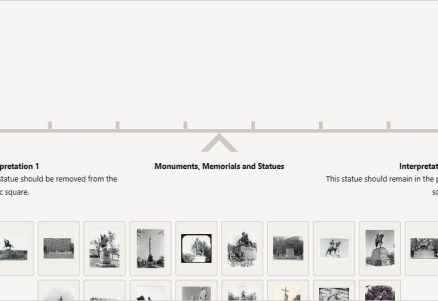
Open the activity and choose one of the photographs of a monument, memorial, or statue. Click on the orange “open in new window” icon to see the image more closely. Model careful document analysis. Tell students that there are three potential options for each monument, memorial, or statue:
- Remain (in its current location as is)
- Contextualize (add full historical details in its current location)
- Remove (to a museum or cemetery)
For the individual monument, memorial, or statue with which you are modeling document analysis, poll students as to their decision. Ask them to explain their opinions. Demonstrate how the scale works. Explain to students that they will place each of the photographs in the activity on the scale based on their careful document analysis.
Next, instruct students to analyze the remaining monuments, memorials, and statues. Tell students to place the works that they think should remain or be removed closer to the ends of the scale, and the ones that should be contextualized in their current locations closer to the middle of the scale.
Following completion of the activity, lead a class discussion on the issue. Discuss which statues students chose to remove, remain, or contextualize. If different groups placed monuments in different categories, ask them to explain and discuss their reasoning.
After completing the discussion, direct students to click on “When You’re Done” to answer the following questions to debrief the activity:
- In general, what was the most important factor in recommending to keep a monument, memorial, or statue? Explain.
- In general, what was the most important factor in recommending to remove a monument, memorial, or statue? Explain.
- What process should be set up to decide which statues to keep or remove? Who should play a role in the decision?
Inform students that many of the statues in this activity have been removed – either by protestors, or by local or state authorities – in the past several years. For others, people have attempted to remove them, or there have been petitions or discussions about their removal. If interested, students can look at each photograph’s detail page (by clicking the “open in new window” icon) to see the current status of each statue.

To the extent possible under law, National Archives Foundation has waived all copyright and related or neighboring rights to “Debating Monuments, Memorials and Statues”
Description
In this activity, students will analyze photographs of monuments, memorials, and statues around the United States and discuss whether or not they should be removed from the public square.