

Cultural Diplomacy and Propaganda During the Cold War

Published By:
Historical Era:
Thinking Skill:
Bloom’s Taxonomy:
Grade Level:
Suggested Teaching Instructions
This activity can be used as part of a unit on 20th century American history with a focus on the Cold War and post-World War II foreign relations. For grades 9–12. Approximate time needed is 45 minutes.
Begin by providing students with historical context on the Cold War and the relationship between the United States, the Soviet Union, and Chile. Define terms such as: propaganda, psychological warfare, and cultural diplomacy. (See the definition of propaganda from the American Historical Association.)
Encourage students to keep the following questions in mind as they complete the activity and analyze primary sources:
- What is the goal of propaganda? Is it always subversive and negative?
- Why and under what circumstances would the U.S. Government want to influence what foreign countries think of the United States?
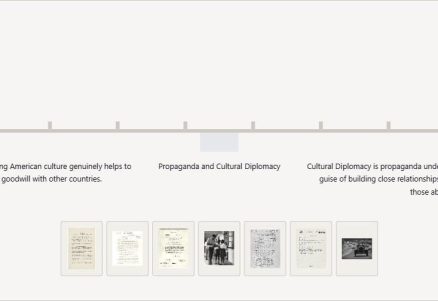
Open the activity and select one of the documents. Model careful document analysis. Explain to students that they will need to place each photograph and textual document on the scale based on careful document analysis.
After students complete the activity, they should click “I’m Done” and answer the questions listed:
- On which side of the scale did most of your evidence fall?
- Why did the scale tip the way it did?
- Do you think the activities of cultural diplomacy constitute propaganda? Why or why not?
Conduct a class discussion based on student answers. Ask students to also consider the following: What might be the outcome of cultural diplomacy for the United States? For foreign countries? What lessons might have been learned?
This activity was created by National Archives volunteer Cynthia Peterman.
