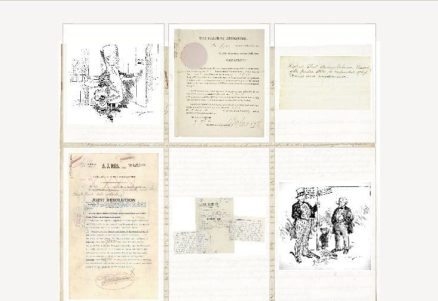
Congress in Article I of the Constitution
Seeing the Big Picture
Share to Google Classroom
Recommended Activity
Published By:
National Archives Foundation
Historical Era:
Across Eras: Civics & Government
Thinking Skill:
Historical Analysis & Interpretation
Bloom’s Taxonomy:
Understanding
Grade Level:
Middle School
Suggested Teaching Instructions
This lesson is appropriate for introducing students in grades 5–8 to studying the text of the Constitution.
Divide the class into pairs or small groups. Ask students to begin the activity, analyzing each document for a possible link to Article I of the Constitution. Students should match each document with one clause from Article I. They will identify six pairs to reveal some of the characteristics and powers of Congress.
Once they have matched the pairs and clicked “I’m Done,” they will be prompted to reflect on the pairs they have identified and the rest of Article I. Hold a class discussion based on the final question:
- What characteristics and powers of Congress justify its being referred to as the “people’s branch of government”?
Follow up on this lesson by having the students use the lesson Teaching Six Big Ideas in the Constitution, from the Center for Legislative Archives at the National Archives.
To the extent possible under law, National Archives Foundation has waived all copyright and related or neighboring rights to “Congress in Article I of the Constitution”
Description
In this activity students will match primary source documents to clauses from Article I of the United States Constitution that detail six powers of Congress. This study will reinforce the idea of separation of powers between branches by highlighting six of the powers the Founders specifically granted to Congress.
Share this activity with your students
Documents in this Activity
Constitution of the United States
Revolution and the New Nation (1754-1820s)
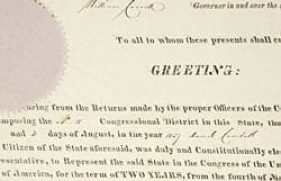
Credential of Election for David Crockett
Expansion and Reform (1801-1861)
Resolution of Impeachment of President Andrew Johnson
Civil War and Reconstruction (1850-1877)