


Confronting Work Place Discrimination on the World War II Home Front

Weighing the Evidence
Share to Google Classroom
Recommended Activity
Published By:
National Archives Foundation
Historical Era:
The Great Depression and World War II (1929-1945)
Thinking Skill:
Historical Analysis & Interpretation
Bloom’s Taxonomy:
Evaluating
Grade Level:
High School
Suggested Teaching Instructions
Many states have an American history standard dealing with either A. Philip Randolph’s success in pressuring FDR to issue Executive Order 8802 or with the idea of evaluating the limited success that minorities had in gaining access to wartime jobs and how they confronted discrimination on the home front during World War II.
This activity is designed for upper level high school students (grades 10-12) to form their own ideas about this complex issue. Approximate time needed is 30 minutes (excluding the writing assignment).
Objectives:
- Students will formulate a position about the effectiveness of Executive Order 8802 and the government agency it established, the FEPC, in investigating and combating discrimination.
- Students will write a short composition (4 or 5 paragraphs) arguing their formulated position.
Steps:
- Share the following background information with students (for more information see the September 2013 National Council for the Social Studies (NCSS) publication Social Education article “A. Philip Randolph’s Attempt at Equal Economic Opportunity: A Case Study“):
In the early months of 1941, A. Philip Randolph began organizing a “march on Washington” to protest the lack of opportunity that African Americans had in the booming war industries as America prepared to enter WWII. To prevent the march, FDR issued Executive Order 8802 providing equal opportunity in defense industries “without discrimination because of race.” To investigate complaints, the order also established the Fair Employment Practices Commission (FEPC). Many historians think that the FEPC was powerless and ineffective, while others think it was a step forward. An incident at a Liberty Ship plant in Mobile, Alabama, serves as an example to question the FEPC’s effectiveness.The FEPC in 1943 was encouraging the hiring of black welders on segregated work areas but in May the plant unexpectedly placed black welders alongside white welders. The white workers in the plant rioted. The FEPC negotiated an agreement in the plant that allowed for the black workers to be trained and promoted into skilled jobs but placed on segregated work stations (called “ways”). Prior to this event and subsequent agreement, African Americans held unskilled positions. Was the outcome of this event a step forward in the advancement of Civil Rights and, if so, to what degree was it effective?Post Script: After WWII, the FEPC almost became a permanent agency, but a strong voting bloc in Congress prevented it. Shortly after the dismantling of the FEPC, President Truman issued Executive Order 9981 banning segregation in the military. Was A. Philip Randolph satisfied with the results attained by his threatened “March on Washington Movement” and the FEPC? Perhaps not, as he was a driving force of another march on Washington, this one occurring in 1963.
- Once students enter the activity, they will examine each document and decide which of two interpretations the document supports.
- Interpretation One: The FEPC did improve economic opportunity and lay a foundation for the Civil Rights Movement of the 1950s and 1960s.
- Interpretation Two: The FEPC did not improve economic conditions for African Americans and did not effect the coming Civil Rights Movement of the 1950s and 1960s.
- Using the results of the activity, students will write a short composition (4 or 5 paragraphs) supporting one of the interpretations and email it to the teacher.

To the extent possible under law, National Archives Foundation has waived all copyright and related or neighboring rights to “Confronting Work Place Discrimination on the World War II Home Front”
Description
In this activity, students will analyze primary sources and evaluate the degree to which they demonstrate Civil Rights advances following President Franklin Delano Roosevelt’s 1941 Executive Order providing equal opportunity in defense industries, and the subsequent establishment of the Fair Employment Practices Commission (FEPC).
Students will place documents on a scale according to their weight as evidence of advancement or ineffectiveness of the FEPC. They will then formulate their own position on the effectiveness of the executive order and commission, and write out their reasoning and evidence for their formulated positions.
Share this activity with your students
Documents in this Activity
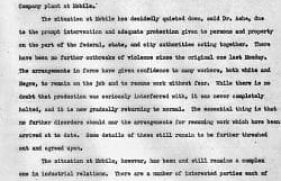
Statement from Dr. B.F. Ashe, Regional Director of the War Manpower Commission, concerning the recent race and labor disturbances at the Alabama Drydock and Shipbuilding Corporation in Mobile, Alabama
The Great Depression and World War II (1929-1945)
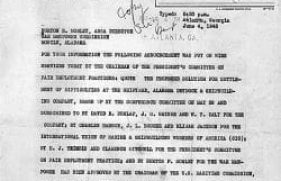
Telegram relaying the announcement regarding pay discrepancies
The Great Depression and World War II (1929-1945)

United Press release relating to the walkout of white welders at the Pinto Island shipyards at the Alabama Dry Dock and Shipbuilding Corporation
The Great Depression and World War II (1929-1945)