

Comparing Three Drafts of the Constitution

Compare and Contrast
Share to Google Classroom
Recommended Activity
Published By:
National Archives Foundation
Historical Era:
Revolution and the New Nation (1754-1820s)
Thinking Skill:
Historical Analysis & Interpretation
Bloom’s Taxonomy:
Evaluating
Grade Level:
High School
Suggested Teaching Instructions
This activity can be used to introduce the Constitution and the concept of self-government. It would also be appropriate during a unit on the Constitutional Convention and the ratification process. For grades 6-12.
Before beginning activity, share the following details with students:
Fifty five delegates from across the United States met as part of the Constitutional Convention in Philadelphia, Pennsylvania, from May 25, 1787, through September 17, 1787.
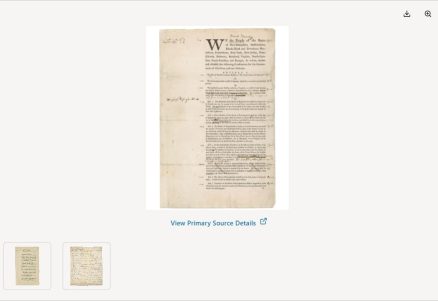
When drafting the Constitution, the delegates established a Committee of Detail that was tasked with preparing a draft of a Constitution that reflected the resolutions that had been approved as of July 23, 1787. The members of the committee included John Rutledge (SC), Nathaniel Gorham (MA), Oliver Ellsworth (CT), Edmund Randolph (VA) and James Wilson (PA). The Committee of Detail shared printed drafts with the rest of the delegates on August 6, 1787. For the next several weeks, the convention reviewed, debated and edited the resolutions. This copy of the first draft is from David Brearley, a delegate from New Jersey, and it includes his notations of revisions in the margins of the Convention’s work. The National Archives also has another copy with George Washington’s annotations.
On September 8th, delegates appointed a committee to revise and arrange the agreed upon articles of the Constitution. The five members of the Committee on Style and Arrangement were Alexander Hamilton (NY), William Johnson (CT), Rufus King (MA), James Madison (VA), and Gouverneur Morris (PA). Several days later, on September 13, 1787, the committee share an updated printed draft. This copy (the second document in the activity) is also from David Brearley and includes handwritten annotations of the changes the delegates made after this draft was printed.
Finally, on September 17, “by the unanimous consent of the States present,” 39 delegates signed the handwritten, engrossed copy of the Constitution (the third document in the activity) and then submitted it to Congress for transmittal to the states for ratification.
Direct students to take a minute to examine the first draft of the Constitution from July 23, 1787. As a class, model document analysis. Ask students to describe the document as if they were explaining it to someone who can’t see it. What details stand out? What do you notice? What questions do you still have?
After noting their initial observations about the first draft, ask students to explore the second draft of the Constitution from September 12, 1787 individually or in small groups. Again, students should focus on analyzing the primary source document and note their observations (how does it appear, what details stand out, etc).
Students should also note the major similarities and differences between these first two drafts. Direct students to focus on the style, tone, organization, appearance, and message as they compare and contrast the first two documents. Details they may observe include a revised Preamble, a different number of Articles, and significantly fewer annotations and edits on the second draft of the Constitution.
Quickly direct attention to the final engrossed Constitution of the United States. Share the following details:
The delegates approved the draft of the Constitution on September 15, 1787. The signing was set for the very next Monday. Jacob Shallus, the assistant clerk for the Pennsylvania General Assembly, agreed to engross (copy in a fine, clear hand) the document. Over the course of about 40 hours, he created an accurate transcription of the draft. He was paid $30 for his efforts.
On September 17, the document was ready for signing. Thirty-nine of the 42 men present signed the Constitution. George Washington was first, followed by each state delegation descending from north to south. George Mason, Elbridge Gerry, and Edmund Randolph refused to sign because the Constitution lacked a bill of rights.
This engrossed copy is on display in the Rotunda for the Charters of Freedom in the National Archives Building in Washington, DC.
Direct students to the “When You’re Done” section and discuss their findings.
- Which difference do you think is the most important change that occurred between the initial draft and the final ratified version? Why?

To the extent possible under law, National Archives Foundation has waived all copyright and related or neighboring rights to “Comparing Three Drafts of the Constitution”
Description
In this activity, students will examine three versions of the Constitution of the United States–the first printed draft from August 6, 1787, the Committee of Style and Arrangement’s printed draft from September 13, 1787, and the final, engrossed copy signed by the delegates on September 17, 1787.
Share this activity with your students
Documents in this Activity

Printed Draft of the Constitution Brought in to the Convention by the Committee on Revision of Style
Revolution and the New Nation (1754-1820s)

Constitution of the United States
Revolution and the New Nation (1754-1820s)